Andrew Boff, local resident and Conservative spokesman at the London Assembly on East London & the Olympics, has found minutes from September 2009 recording that the total cost of Dalston's Olympic bus stop could be £62.9 million, not £40million. £23 million over budget. See the minutes here -para 2.11.
He gave an ITV news interview on Wednesday and raised a question regarding the issue with Boris at GLA Mayor's question time yesterday. Also present was the Labour representative for Hackney and east London, Jeanette Arnold - a cheerleader for TfL's Dalston Olympic bus stop . She seemed to take it all a bit personally.
Jennette Arnold AM, former Chair of the London Assembly is pictured with Denis Oswald, Chair of the IOC Coordination Commission (left) and Sebastien Coe, Chair of the London Organising Committee.
You can watch the politicians discuss the issues on the GLA webcast here (scroll though to 01:47:00) but, in summary, it went something like this:
Boff: Can it possibly be true that The Slab in Dalston cost not only Dalston's heritage buildings but £62.9 million of public money? It says so in the LDA's minutes.
Boris: I will just read parrot fashion what I've been told to say. But £40million seems a lot to me for a concrete slab. I will ask questions of TfL today.
Arnold: The Dalston demolitions and The Slab are quite seperate. You're confusing my constituents... Bugger off Andrew...You can't tell me anything about Dalston Mr Boff. Go away! Go away!
Chair: Jeanette you're out of order. That's enough. Settle down please.
Ms Arnold suggests that The Slab had nothing to do with the demolition of Dalston's heritage buildings. But a letter from the GLA London Development Agency's Chief Executive, Manny Lewis, dated 29.11.06, to Lord Low (OPENs Patron) stated that, on the advice of it's architects ARUP (which designed the Barratt's tower blocks to replace them), "the buildings fronting Dalston Lane make very little contribution to the streetscape" and that "the provision of the over-station slab is reliant on a viable development scheme on the Dalston Lane site".
The LDA also wrote to the High Court judge to say The Slab scheme was in danger of collapse and urged him to lift OPEN's injunction which was preventing the demolitions.
The LDA repaid Hackney the cost of the demolitions.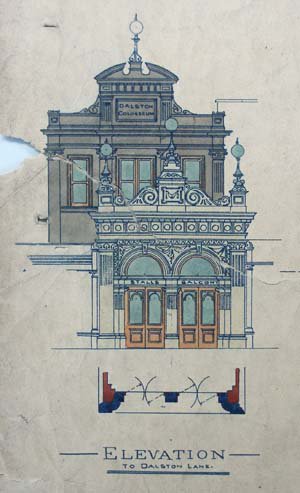 This 1898 architect's drawing is of the entrance to Dalston's Theatre of Varieties, which was at 12 Dalston Lane. It was built in front of the original 1886 circus entrance ( the earliest surviving example in the UK - designed by Alfred Brandreth). An urban gem. These buildings were described by the LDA's Chief Executive, as "making very little contribution to the streetscape". Shortly afterwards the buildings were demolished.

Friday, 11 June 2010
Andrew Boff finds it. Jeanette Arnold loses it


Thursday, 3 June 2010
Four slow deaths on Ashwin Street. And a burial.
As we reported last week, after decades of squatting and then dereliction, Hackney are now hell bent on demolishing rather than retaining anything of its four charming old houses at 2-8 Ashwin Street. This is how the facades of 2-8 Ashwin Street looked in 2003, after 20 years of Hackney ownership.
Following extensive public consultation last summer, in which OPEN led a detailed community response, Hackney's draft Dalston Area Action Plan acknowledged the importance of the old houses to the Ashwin Street Character Area.
This is what the Plan says:
Development at 2 – 8 Ashwin Street: Any redevelopment and/or refurbishment of Nos. 2 – 8 Ashwin Street is encouraged to consider the retention of the existing buildings and/or existing building façade. However, if full or partial retention is not viable, and is clearly demonstrated that demolition is the only practicable option, its removal will be considered as part of any proposals to develop the properties for a landmark exemplar building that will contribute positively to the character of Ashwin Street and Dalston Park.
So why is demolition proceeding now? Particularly when it is not part of any proposal for a "landmark exemplar building" to replace the old houses?
 This is how 2-8 Ashwin Street looked today with demolition well under way
OPEN has now heard back from Hackney's solicitor who informs that the decision to demolish was made by it's Chief Executive "to maintain public safety" following "police reports". The houses have fallen into a dangerous condition.
We have also received a copy of Hackney's recent structural engineer's report following an external inspection. His report commented on distortion to the front walls of the houses, worsened by fire damage, and that "to ascertain the exact extent of wall sections worth retaining, would require a full... survey". But, it appears, no such full survey was undertaken. Hackney has refused OPEN's specialist engineer access to provide a second opinion. Hackney are proceeding to demolish the lot. Ashwin Street on the morning when Number 8 was gutted by fire on 31.7.08 . The facades of the old houses frame the view of the locally listed Reeves Printhouse.
Where a building has become unsafe due to dereliction there is an exception to an owner's right to demolish. It is designed to prevent the mischief of owners using their own neglect or vandalism as an excuse to demolish residential houses without planning control. In those cases the owner must apply for full planning permission - unless it can show the building can not practicably be made safe or temporarily supported.
In the present case there already is shoring supporting the houses. And Hackney's engineer has described what would be needed to retain part and rebuild the remainder of the houses' facades. But no advice was given about what is needed to make the houses safe. But, despite ignoring that requirement, Hackney claim there is no need to apply for planning permission to demolish them.
 2 Ashwin Street today, half demolished, with a glimpse of the Dalston Lane Peace Mural in the background.
Regular readers of this blog may now be experiencing of sense of deja vu. When Hackney sought to justify demolition of Dalston's circus buildings and locally listed Georgian houses in 2005 it also referred to fires (whereas there had been none), that its surveyors had inspected all the buildings (which they had not), that they were all beyond repair (which they were not) and that they did not need planning permission to demolish them (but a High Court Judge agreed with OPEN that they did).
But then Hackney went on to grant itself planning permission and destroyed them anyway. And now Ashwin Street follows on. If you believe what Hackney says of itself ("We are the champions of the historic environment") then why is Building Design magazine this week publishing accusations by national and local amenity societies of Hackney's "cultural vandalism" ?
 The former site of Dalston's Circus and Georgian houses destroyed by Hackney Council with the approval and agreement of Transport for London, the London Development Agency, the Greater London Authority and the Secretary of State, to fund Dalston's £40million bus stop.
The Vandals: an eastern Germanic tribe which earned notoriety by sacking Rome in the 5th century but which was defeated by the Goths.
Vandalism: the gratuitous anti-social destruction of the environment and artistic creations.
Municipal vandalism: the destruction of our cultural heritage by corporate ignorance, deliberate neglect, vanity and greed all in the name of progress.
How did it happen?
Read the posting "The story that was never told" for a more detailed history.
Wednesday, 26 May 2010
Boris is coming! Quick!! Demolish Old Dalston
OPEN has learned from demolition contractors on site that four old houses at 2- 8 Ashwin Street must be pulled down and levelled by 5th June because Boris is coming. 2 Ashwin Street - the ninth "opportunity site" to burn down in Dalston in recent years. A squatter threw himself from an upper floor, during the fire on 31.7.08, with tragic consequences.
Hackney has owned the terrace of charming old houses since the 1980s. But it has never maintained or repaired them. It says that their condition has now become so dangerous they must be demolished immediately. There is no time to even consult the public or get planning permission to demolish them.
So the timing of the demolitions, by 5th June, is apparently nothing to do with the Council's "Dalston Connected" street party on Sunday 6th June to take place in Ashwin Street. This PR event is to celebrate the Dalston Junction overground station re-opening and Dalston's new £40million Olympic bus stop. Boris is to be the guest of honour.
 2-8 Ashwin Street front walls were shored up after the fire, to stablise them, over 12 months ago. But the rear walls got no such protection.
In the Council's various public consultations since 2005 onwards our community has expressed a clear preference for re-use of the historic Ashwin Street old houses. Re-use is sustainable and would preserve the human scale and character of Dalston.
OPEN, Arcola Theatre and other community groups sent a deputation to Hackney's Mayor, Jules Pipe, on 26th October 2009. His Cabinet agreed "to defer demolition subject to further survey and discussion with interested parties, to determine the feasibility of retention". But there's been no such discussion and Hackney has refused to supply the survey report.
But at the same Cabinet meeting, OPEN has discovered, the Cabinet also agreed "that the Council lets the contract for the demolition to Clifford Devlin for the sum of £170K".
And over the same period the Council has also been buying up other sites in Ashwin Street, one at over market value, for redevelopment "as a natural progession of the Dalston Square development to the south" .

Looking north at 2-8 Ashwin Street and Barratt's Dalston Square towerblocks under construction
OPEN solicitors have written to the Council demanding to know why the buildings suddenly have to be demolished by 5th June and why no planning application is first to be made and the public consulted.
We are grateful for the research assistance of Loving Dalston, the independent Hackney news site.
Thursday, 20 May 2010
A satirical image
 (Click on image to enlarge)
In view of the emerging scandal of Dalston's £40million Olympic bus stop OPEN would like to take this opportunity to correct some of the glaring inaccuracies this image contains.
Just for starters. Lord Low of Dalston's job is NOT to represent Dalston - he is a cross bench "people's peer" who sits in the House of Lords for the greater good.
And secondly, for the record, Lord Coe DID come first (two Olympic Gold Medals in fact when he was just humble Seb Coe).
If you wish to point out any other inaccuracies please add them as Comments below. It's (still) free. Ed
Thursday, 13 May 2010
Lord Low condemns the authorities' gross extravagance

That sense of outrage is palpable. It hangs like a black cloud over Dalston, along with the smoke of nine development sites that have burnt down in Dalston recently. But the outrage isn't because we wanted to see more buses terminating at TfL's Transport Interchange. OPEN had objected to the whole scheme from the beginning. And in 2006 we told the authorities that building The Slab was "not a prudent use of financial and natural resources" and that, if they went ahead, it would be "The most expensive bus stand in history".
In February 2007 OPEN's Patron, Lord Low of Dalston, alluded to the pending scandal when making his maiden speech in the House of Lords.
 Colin Low, CBE, is Lord Low of Dalston, Vice-President of the Royal National Institute for the Blind and President of the European Blind Union. He lives in Dalston
But the authorities pursued their reckless Slab scheme and Lord Low went into further detail in a later speech in the Lords which you can read here.
Lord Low has written to the local paper's Editor this week to explain OPEN's position further regarding The Slab. This is what he wrote:


Thursday, 29 April 2010
The scandal of Dalston's £40million Olympic bus stop
Whilst politicians have recently been scrambling to take credit for the reopening of the East London overground railway to Dalston Junction they have, unsuprisingly, been silent about the scandal of Dalston Square’s £40million bus stop. Dalston's £40million Slab over the new station which has been built for a planned bus/rail Transport Interchange.There are 9 more tower blocks to be built on the site to sell and pay for The Slab.
Despite the public outcry, Dalston’s heritage buildings have been demolished, and its environment is now to be blighted by nine further blocks of flats of up to 20-storeys, all for sale (with no affordable housing) to pay for The Slab .
The Slab is a £40million concrete raft over the railway cutting which, we were told, was essential to create a bus/rail Transport Interchange to support the 2012 Olympic bid. And regenerate Dalston. The new barbarism - the authorities vision for Dalston's future "regeneration"
But now we have learned, from TfLs replies to Lord Low of Dalston and OPENs Freedom of Information Act requests, that only one bus will use The Slab - the 488 , the route of which is to be extended from Clapton to Dalston. There are no plans for London Buses to use the Slab for other bus routes terminating in Dalston and as for through route buses, they say, diverting them to use The Slab would just delay passengers. (Shouldn't they have thought of that before? Ed.)
So there we have it - the destruction of old Dalston’s Town Centre was to finance a £40million Olympic Transport Interchange for use by just one bus that doesn’t even go to the Olympic site (and neither does the train).
With schemes of such monumental environmental and financial extravagance, and pointlessness, no wonder our government is bankrupt and the electorate disenchanted. But how could the public have been so mislead? In a culture of official deception just remember that old adage “Don’t believe anything in politics until it's been officially denied”.
PS TfL have also said that having the Transport Interchange means bus drivers won’t have to go all the way back to the garage to get a cup of tea. So there’s a comfort.
Thursday, 25 February 2010
Barratt to complete Dalston Square
Barratt are reported to be about to start the second half (the west side) of the Dalston Square development this month. Ken Livingstone's London Development Agency obtained permission for the scheme in March 2006 despite community objections and a Hackney report to it's Planning Committee describing the design as "harsh" and "austere". The development - a row of 9 private residential blocks and shops, of up to 20 storeys, with no affordable housing - will be built on The Slab, a massive concrete raft over TfL's Dalston Junction railway cutting. The Slab, costing over £40 million, has been completed. The development includes Transport for London's "transport interchange" which will serve the reinstated East London Line station and the new bus turnaround behind it. The design of the station's entrance is not to everyone's taste .
In the depths of the credit freeze there were doubts whether Barratt could proceed. It has sustained eyewatering losses approaching £800 million over 2 years. Like all volume house builders it has been pleading with bankers to relax mortgage restrictions which have been affecting new-build sales and freezing out first time buyers who can't raise the 20% deposits bankers are demanding. With assistance from government bail out schemes, like HomeBuy Direct which helped first time buyers bridge the funding gap, 'Too Big to Fail' Barratt were able to advertise "half-price" deals on some of the Dalston Square flats.
Debt-laden Barratt's financial problems have been relieved by favourable conditions for absentee landlords. Recent reports have described how two-thirds of the 5,500 new houses and flats sold in London during the first three quarters of 2009 were purchased as buy-to-let properties. Reports last summer described 'buy to let' marketing of Dalston Square in the far east and the announcements of Phase 1 'selling extremely well' have been talked up by 'massive interest from Far Eastern buyers'. OPEN's concern is the creation of a transient population on shorthold tenancies, which does not create sustainable balanced communities with a commitment to the area. Nearing completion - the east side of Barratt's Dalston Square - a development of 230 flats, shop units and a 3-floor shell for a new public library - is on the Hackney Council demolition site of the former 1886 Dalston Theatre, Georgian listed houses, and what was the oldest circus entrance in the country. The historic buildings were demolished in 2007, despite vigorous community opposition, to create a valuable development site which Hackney Council traded to subsisdise The Slab.
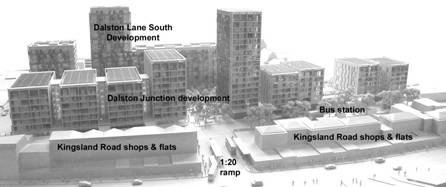 A birds eye view of the authorities' 2006 vision for Dalston. In the foreground are the 9 blocks, which are now to be built above the railway cutting, and the ramp for the 80 buses per hour planned to emerge into the traffic of Kingsland Road and head north.
 More tall storeys. This is the computer graphic used to promote Dalston Square - which some have predicted will be a sunless windswept canyon due to its north/south orientation and the accelerated windspeeds and micro-climates which the tall buildings are predicted to generate.
 This is the authorities' image of Dalston Square, west side, which is about to be started (with graphic additions by an unknown local artist). But will Dalston Square attract the brand name shops which, the authorities said, the scheme's viability and Dalston's 'regeneration' depended upon? Not, it would seem, while the nation's ghost town high streets are being replicated in Dalston.
Dalston Square's completion will be proceeding amidst fears of a 'double dip' recession. Government money for more bail outs is drying up. Even with housebuilders restricting supply to maintain house prices Barratt's own predictions are of a seven year road to a recovery in its fortunes. There will clearly be pressure to downgrade the quality of what is to be built, as some local residents have seen elsewhere.
Nearly four years ago OPEN published "Save our past. Save our future". We predicted Dalston Square could become a buy-to-let opportunity for absentee landlords and become the slums of the future. Elsewhere similar schemes have been rejected. Perhaps these battles are what have prompted Barratt's opposition to popular localism policies. But Dalston Square's cheerleader, Hackney's Mayor Pipe, called the critics the "Keep Hackney Crap Brigade". Although Barratt is one of the 'preferred delivery partners' of the Homes and Communities Agency (which finances social housing) a review by the government's design quango CABE had found much of the publicly funded schemes built were unfit for purpose. But which major housebuilders were churning out rabbit hutches during the boom years is a state secret! Now we are bust can we expect the standards of new-build like Dalston Square to be any better?