Pages

Showing posts sorted by relevance for query quarter. Sort by date Show all posts

Saturday, 25 March 2017

Dalston's "Cultural Quarter" - tell Hackney your views

Hackney Council is consulting on its principles for development of four sites in Dalston town centre. The sites have been designated as a  "Cultural Quarter". All are owned by the Council including part of the Eastern Curve Garden (including its entrances, pavillion and hothouse), heritage buildings and two vacant building sites. All the buildings and land are presently occupied by creative, community and charitable enterprises. The Council's stated intention is to "maximise regeneration benefits" and to "maximise capital value and rental revenue for the Council"
The development areas are Site 1 The former CLR James library and the Georgian houses at 18-22 Dalston Lane. Site 2 The vacant site on Ashwin Street west side. Site 3 The Railway Tavern, 10-16 Ashwin Street east side and the southern part of the Eastern Curve Garden and Site 4 The car park in Abbott Street 

You can meet and discuss the plans with Council officers between 6:00pm - 7:45pm at Dalston CLR James Library on the 23rd March and at Hackney Town Hall (Room 32) E8 1EA on 10th April 
The public consultation closes on 17 April.

You can read OPEN Dalston's analysis and responses here and a summary below. We hope that these will help inform your views and responses to the Council.

You can read the Council's consultation documents here. You can tell the Council your views here.

Summary of OPEN Dalston’s responses

We consider that the Council’s  Development Principles for development of the Dalston Quarter should include the following wording:


a.         Development will not be permitted within the Dalston Quarter which would compromise the existing extent, bio-diversity and continued use of the Eastern Curve Garden and its facilities as an enclosed, secluded and financially sustainable community garden with free public access.The Eastern Curve Garden will be designated as Local Green Space and afforded protection from new development.


The Eastern Curve Garden is a community garden on historic open space which attracts 150,00 people each year. It is where people meet plants, children play and learn safely, a place for solace, for creative and cultural events and it is a wildlife corridor

b.         New development within the Cultural Quarter and on adjoining land, including Thames House and the Kingsland Shopping Centre, will be designed to improve pedestrian permeability through the area without the need to utilise the Eastern Curve Garden as a public thoroughfare


The Council has designated the Eastern Curve, including the Garden, as a hard surfaced public thoroughfare ("shopping circuit"). This image shows that, working with adjoining sites, there are plenty of other opportunities for interesting pedestrian routes through the area without compromising the Garden.  

c.         The historic buildings are the key driver to the regeneration of the Cultural Quarter. They, and their settings, will be safeguarded and enhanced. Alterations to the buildings will not be permitted which harm or cause any risk of future harm to their historic structures and character 


These are the last surviving pairs of Georgian houses at 18-22 Dalston Lane. All the others were demolished either for redevelopment purposes or due to historic neglect.  

d.         Only professional consultants and contractors with conservation accreditation and expertise will be appointed to deal with historic buildings.


We consider that these buildings at 10-16 Ashwin Street, designed in 1870 by Edwin Horne,  and the former Victorian factory behind them, are of high heritage, aesthetic, cultural and communal value. Any intervention would require considerable expertise to avoid loss or damage to their character and significance

e.         Any new development will preserve and enhance the setting of historic buildings and of open spaces and their amenity.


The buildings Ashwin Street have had a historic association with the visual and performing arts since 1870 and are still fully occupied by artists and other creative businesses today. Extensive work to these, and the other buildings, and higher rents, could see the existing uses permanently displaced. 

f.          Affordable workspace presently used for cultural, charitable and community (third sector) activities will not be reduced in its amount and will be enhanced in quality

g.         Section 106 planning agreements will secure developer contributions towards the conservation of the area's heritage and the support of the cultural, charitable and community uses to which the land and buildings are put


The Railway Tavern, built in 1868, is in a prominent position at 11 Dalston Lane. “The building cannot be demolished without loss of heritage significance to this part of Dalston.”

h.         Cyclists will be required to dismount in areas of pedestrian public realm save where there are safe demarcated routes for cyclists. If the Council insists upon implementing "shared space" for cyclists and pedestrians it should consider requiring cyclists using such space to have third party accident insurance 

i.          Access for motor vehicles from Dalston Lane into, and parking in, Ashwin Street will be removed other than for those with disabilities. 


The Reeves factory for artists' paints was designed in 1868 by Edwin Horne and is now occupied by Arcola Theatre, Cafe Oto and the Bootstrap Company with numerous small independent enterprises

j.          Any new residential development will be sufficiently remote from performing arts venues within the Cultural Quarter so as to avoid conflict between different uses 

The Council's public consultation closes on 17 April.You can read OPEN Dalston's detailed responses here  We hope that these will help inform your views and responses to the Council. You can tell the Council your views here.

Back stories:

Why is Hackney misleading the public about Eastern Curve Garden?


Hackney's monstrous plan to "regenerate" Dalston's Eastern Curve Garden

Wednesday, 29 March 2017

Hackney Mayor fails to deny Eastern Curve Garden will be redeveloped

In response to Hackney's public consultation on its Principles for Development of the Dalston Cultural Quarter we sent our representations to the Council this week and let people know on twitter @OPENDalston. You can read what we said to Hackney here
There has been huge public concern about the Council's plans because development site 3 includes the Council owned part of the hugely popular Eastern Curve Garden . Some fine heritage buildings and affordable workspaces for local community and creative enterprises are also to be part of the Dalston Cultural Quarter deal.


We next had a tweet from Hackney's newly elected executive Mayor Philip Glanville. This is what he said.


It was great that Hackney Mayor wanted us to "be clear" about the Council's intentions. But how clear was he? He said the Council wasn't consulting the public about developing the Garden. And that Hackney didn't intend to develop the part of the Garden owned by Kingsland Shopping Centre.
But what about the entrance and 25% of the Garden's land which is owned by the Council? Hackney's Garden land is included in development Site 3 and its' stated intention is to dispose of all four sites to a single "development partner"  to "maximise capital value and rental income for the Council " (see paragraph 7 of its' Cabinet Report)


The Mayor didn't deny that the part of the Garden owned by Hackney would be included in the development deal, just that it wouldn't be a "traditional disposal" and that, anyway, it was "a long way off".
But if the Council hasn't ruled out development of its Garden land why has it been included as part of development site 3 for a 'non-traditional disposal' at all?


Ah - so even if the Garden land is to be part of a  'non-traditional disposal' to a developer we should not assume it will all be completely developed over.  But if Hackney's part of the Garden could be developed on, why are Council officers refusing to consult the public about its future?


So Hackney is consulting on ensuring the "best of Dalston is preserved" - namely heritage, community organisations, culture and workspace. But what about the only, and much loved, local public green space? The Eastern Curve Garden is, notably, not on the Mayor's list and, as the Mayor said from the start, the Council is not consulting the public on the development of the Garden. 

Is that clear now? The Council owned part of the Eastern Curve Garden is included in development Site 3. In due course it will be part of a 'non-traditional' disposal to a single "development partner". The Council is not consulting the public about the Garden's future, because is not part of "the best of Dalston" to be "preserved". And we must not assume that it will be developed over entirely - some of it might be left undeveloped ( Enough for a public thoroughfare perhaps? Ed.)  

What is clear is that the Mayor has failed to deny that the Garden could be developed as part of the Council's Cultural Quarter plans.


Hackney's vision for the future of the Garden - enshrined in the 2013 Dalston Area Action Plan - a public thoroughfare along the Eastern Curve linking Dalston Lane with a redeveloped Kingsland Shopping Centre 

You can read OPEN Dalston's analysis and responses to Hackney's Cultural Quarter plans here. We hope that these will help inform your views and responses to the Council.You can meet and discuss the plans with Council officers between 6:00pm - 7:45pm at  Hackney Town Hall (Room 32) E8 1EA on 10th April. You can also tell the Council your views here. The public consultation closes on 17th April


Backstories

Dalston's "Cultural Quarter" - tell Hackney your views

Why is Hackney misleading the public about Eastern Curve Garden?

Hackney's monstrous plan to "regenerate" Dalston's Eastern Curve Garden


Sunday, 16 March 2025

Dalston's "Creative Quarter" and community Eastern Curve Garden are again officially at risk

On 24 March Hackney's Cabinet will be considering the sale of some family silver - sites it owns in Dalston's "Cultural Quarter". The sites include 10 -14 Ashwin Street, townscape buildings which are locally listed and in the Conservation Area. They are currently providing affordable studios for 30-40 artists and have a long cultural legacy, including performance arts, since the 1980s. The site also includes the Eastern Curve Garden's only indoor space - its "Hothouse" meeting place, office and toilet. How will the Garden survive if it loses those, on top of having a redevelopment site next door?

Cash strapped Hackney is said to be seeking a sales valuation based on demolition of the buildings and re-development as luxury flats. It has already said that all the artist tenants must leave by 1st April, because the buildings have suddenly become 'too unsafe' to remain. The Eastern Curve Garden is also partly on the site so a future purchaser could decide its Hothouse and facilities have to go too. 

The sell-off is part of a plan to privatise Dalston's "Cultural Quarter"sites first revealed in 2018. The buildings have a rich legacy of cultural and community benefit, but this has yet to be appropriately valued by Hackney. Responding to community outcry in 2018, Hackney's previous Mayor appeared concerned to ensure that preservation of the local heritage, culture, community benefit and affordable workspaces was fully considered. ( What has changed...will the new Mayor feel the same way? Ed.)

10 -14 Ashwin Street was designed by the eminent Victorian architect Edwin Horne in 1870. The frontages have decorative brick, stone and iron work detailing although these are presently disfigured by shabby white paint. Edwin Horne's other houses in Ashwin Street were demolished by World War II bombs and in 2010 by Hackney Council. He also designed the Reeves and Son Artists Colourworks at 18-22 Ashwin Street and the stations at Hackney Central and Grade II Listed Camden Road.


To the rear of 14 Ashwin St is the former engineering works of Tyer & Co who, in 1852, invented the railway signalling system which was adopted throughout the UK and in France. Consultants, instructed by Hackney, reported that this former factory is of HIGH historic value as forming  part of Hackney's industrial legacy.

Entrance to Ashwin St. off Dalston Lane around 1900 - the Railway Tavern's design is also attributed to Edwin Horne

Between 1985 and 1994 the buildings were occupied by the registered charity, Pyramid Arts Development. Pyramid had raised government and charitable grants to buy and renovate the building particularly for the Black community to teach and promote performance arts. The former Government Minster Sir George Young 6th Baronet personally visited to wish them well - as achive film footage reveals. But for some mysterious reason the buildings were bought in the Council's, and not in Pyramid's, name. Hackney seems to think there are now no charitable or other constraints against their sale. 

Pyramid's musicians included the Grammy Award nominee Steve Marshall, Lee 'Scratch' Perry and the American jazz prodigy Clifford Jarvis who mentored many British jazz musicians there. Early participants included internationally acclaimed  Courtney Pine - a founder of the Jazz Warriors.  Also in 1985, Deborah Baddoo MBE opened a dance studio there which focussed on dance and choreography. Since 2005, under V22's ongoing studio management, many eminent visual artists have benefitted from the facilities including Dame Phyllida Barlow DBE RA, Fernando Marques Penteado, Peter Kennard, Fergal Stapleton and others. 


Could Hackney's latest planning policies save the Cultural Quarter from destruction by the mammonists? The recent Hackney Plan 2033 aspires to protect the Eastern Curve Garden and to resist developers seeking to demolish heritage buildings and changing affordable and cultural uses into luxury flats. But the local cultural economy and heritage buildings are fragile. Even if a private developer promised to try and save the facades of 10-14 Ashwin Street, and give its scheme a new cultural gloss, public ownership and the local vibe will be lost. Like the houses of Dalston Terrace which were sold off, demolished and then re-built in "heritage likeness" with no affordable housing at all.

What can you do about this?
You could write to the newly elected  mayor@hackney.gov.uk  to express any concerns which you have. Does 10 - 14 Ashwin St really need to be sold? If so, couldn't there be a binding condition for refurbishment only and for continuing cultural uses? Doesn't obtaining "best value" include valuing existing social and community benefits as part of the reckoning?

This short 2018 film "Dalston Arts 150" reveals Dalston's 150 year long association with the arts and Hackney's original plan to sell off Dalston's Cultural Quarter sites to "maximise capital value and rental revenue for the Council". That plan could now be realised - the privatisation and loss of public cultural spaces.


Tuesday, 28 February 2017

Hackney's monstrous plan to "regenerate" Dalston's Eastern Curve Garden

Dalston's much loved Eastern Curve Garden has alerted its users to the extreme risks it faces from Hackney Council's latest plans to "regenerate" the Garden as part of what it calls Dalston's "Cultural Quarter".


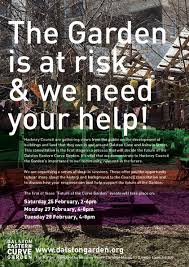
You can find out more about these threats by attending one of the forthcoming "Future of the Garden" information events and by following on Facebook and Twitter @easterncurve


Hackney owns all four of its Dalston "Cultural Quarter"sites including a large part of the Eastern Curve Garden. In November 2015, without any public consultation, it decided to sell them as a single "comprehensive development/refurbishment" package for "regeneration". It considered that this strategy would "maximise capital value and rental revenue for the Council."

 
Hackney has refused to disclose its property valuation report on grounds of commercial confidentiality. More demolitions and luxury flats, and the loss of existing affordable work space, are likely ( Although the opposite is said. Ed.).

This Council map illustrates its carve up of the Dalston "Cultural Quarter". It shows that the Peace Mural entrance and a large part of the Eastern Curve Garden has been included in the Ashwin Street (east) development site Site 3. We wrote about Hackney's "regeneration" plans previously. The Garden was included then too.  (Despite objections. Ed.)


The Eastern Curve is a former railway cutting which had been safeguarded against development for possible re-use as a railway line. The site was opened to the public in 2009 for the temporary Dalston Mill art installation and in 2010 the use continued as a community managed public garden. 


TfL released the safeguarding and transferred the southern part of the Eastern Curve to Hackney and the remainder to the owners of Kingsland Shopping Centre. The Dalston Eastern Curve Garden now occupies both landholdings, but Hackney is only consulting about its own part which it has included within the Ashwin Street East Site 3.    


Hackney's latest "Cultural Quarter" consultation is with its "key stakeholders and the local community" . It says it's about "delivering the vision of the Dalston Area Action Plan (DAAP)". The DAAP had originally proposed a linear park along the Eastern Curve - “a  largely green open space". But after public consultation had closed, Hackney's vision and plans changed to a proposed "shopping circuit",


Hackney's "regeneration" vision for the Garden involves a hard-surfaced public thoroughfare which would link Dalston Square with a redeveloped Kingsland Shopping Centre, with shops and cafes having "active frontages" spilling out onto the route.
The presently secure and intimate environment of the existing Eastern Curve Garden, and its economic self-sufficiency, would be lost forever. ( Have you tried their café's delicious cakes? And the pizzas? Great value! Ed)


The Council claims the Eastern Curve Garden needs to become a public thoroughfare to provide  "pedestrian permeability" from Dalston Lane to a redeveloped Kingsland Shopping Centre. But look at all the potential routes available if only Hackney wasn't deaf and blind to the possibilities.

Dalston is an area recognised as severely deficient in green open space.The finally adopted DAAP, at pages 56 and 57, does at least acknowledge that "the successful community garden... is one of the many types of spaces that could be possible" for the Eastern Curve.


There is free public access to the  Eastern Curve Garden. It is a  place where people meet plants. It's where children can learn and play safely. A place for growth, creativity and solace amidst the hustle and bustle of Dalston Town centre's redevelopment.
 Its an urban wildlife corridor.

We will have to convince the Council of the need to preserve and enhance this essential community resource. If we fail there will be one very disappointed and angry community.


Tuesday, 11 April 2017

Well done Dalston! Council rattled over Eastern Curve Garden plans

In the wake of hundreds of community objections, Hackney Council has announced that it has "clarified" its proposals for development of the Dalston Cultural Quarter. Hackney has also advised that the public consultation period has been extended from 17th until 30th April and that there will be a further public consultation before any developers' brief for its four Dalston sites is finalised. So well done Dalston for speaking up! (And thanks Hackney for listening! Ed).


Karina Townsend's short film "Fanfare for the Curved Garden" featuring last Sunday's performance with Jaime Lucy's "Rucksack Cinema" projections and Andy Diagram's trumpet soundscapes. Dalston's Cultural Quarter keeps regenerating itself! 

The first of Hackney's corrections relates to the Eastern Curve Garden. The Council had refused to consult locals about the future of the Garden, although it is included in development Site 3. It had stated "The Garden isn't included in the consultation". But now Hackney has shown the Garden on its consultation map and it states on line "the Council is open to exploring the potential to retain a community garden". This means that the Council will now actually consider the flood of representations that are being made urging Hackney to keep the Garden. So, if you haven't yet told Hackney what you think, do so before 30 April.


The second major correction relates to its misleading description of the heritage value of 10-16 Ashwin Street. It had previously stated "The frontage of Nos 10-16 Ashwin Street is of historical value whilst the blocks to the rear are of LOWER historical value". This gave the impression that demolition of the rear would not be significant. Hackney has now acknowledged that this contradicted the independent heritage advice it had received. It has now stated on line "the front and rear of No. 10 - 16 Ashwin Street is of HIGH historical value".


These developments don't necessarily mean that our Garden and heritage buildings will be saved. (But it's a good start! Ed.). It is still very important that people continue to make their views known. You can read OPEN Dalston's analysis and responses to Hackney's Cultural Quarter plans here. We hope that these will help inform your views and responses to the Council. The public consultation now closes on 30th April.  You can tell the Council your views here.    

Tuesday, 25 September 2018

Hackney's "Dalston Conversation" - do you want to talk?

Hackney Council has launched a new website on which people who live, work or play in Dalston can express their hopes and fears for our local future. You can read Hackney's publicity about the Dalston Conversation website here and why they say they have created it.

Last year Hackney resolved to dispose of these town centre sites, in and around Ashwin Street, to a developer to "maximise" the financial return to the Council . They call the sites the "Cultural Quarter". All are owned by Hackney, many are of heritage value, and all are presently occupied for affordable cultural and social uses. Could Hackney change its plans and instead work with the community to set up a Development Trust, to improve and expand these uses, without selling them off?  What do you think? You can comment on the Dalston Conversation map

How does the conversation work?
On the Dalston Conversation home page you'll see "View map and comment". A click on that takes you to the local map. There's lots of speech bubbles on the map and you can click on them to see what others have said - and then you can click on Agree and Share those comments. At the top right corner of the map, in the menu bar, you will see "+Have your say". Click on that and you can then stick a virtual pin in the place you want to talk about and type in your comment. Other people can then agree with and share your comment. Hackney may well place greater weight in future on people's shared concerns and on those comments which most people agree with.


This photo is of the Halloween event at the Eastern Curve Garden last year ( Don't miss it this year! Ed.). The Garden has been under constant threat of being turned into a hard-surfaced shopping circuit linking Dalston Square to Kingsland Shopping Centre. Do you think the Dalston Area Action Plan for the Garden should be changed to protect and expand the Curve Garden? You can comment on the Dalston Conversation web page

Is it a conversation with Hackney? 
Not exactly - the map isn't interactive in the sense that you can have a 2-way conversation with people who have commented or with Hackney. But Hackney says there is more development coming, it's listening to the community, and that "your views will help us decide what our priorities should be" and "we want to make sure that our strategy to secure responsible regeneration has your priorities at its heart. Next year, we’ll set out a clear delivery plan based on your feedback." Hackney will also announce face-to-face events throughout autumn so, if you want to know about those, send an email to 


The Dalston Conversation is not just about the "Cultural Quarter". Hackney want to know your views about the pressure for development of future Crossrail2 stations and the Kingsland Shopping Centre. Could Hackney help develop a neighbourhood plan that protects new homes for local people and not just absent investors and buy-to-let landlords - perhaps something like Cornwall's St Ives Council which requires a proportion of owners to actually live in new developments.

Why do Hackney say they're now listening?
When Hackney announced its plan last year, to dispose of it "Dalston Cultural Quarter" sites to a developer it caused a widespread and hostile reaction locally, particularly about the Curve Garden . We wrote about it here and here . The community's reaction caused Hackney to re-think its plans which is why it has now launched this new consultation called the Dalston Conversation.


Some people say gentrification and Hackney's licensing policies are killing Dalston's nigh time culture and economy. What do you think? Could more be done to ensure that there's something for everyone in Dalston? You could make a comment on the Dalston Conversation map.

Can you be bothered?
You may think, from past experience, that your views will make no difference. Whats changed? The local public's reaction and views expressed last year did cause Hackney to at least re-consider its approach. It's interesting and sometimes surprising to see what other people have to say on the Dalston Conversation website.  Whatever your concerns  - for Ridley Road market, the Curve Garden, historic buildings, affordable homes and work spaces, playgrounds, culture and nightlife, local crime, air pollution - it only takes a couple of minutes to agree with a comment, and to make your own comments. ( Why not give it a try - what's there to lose? Ed) 


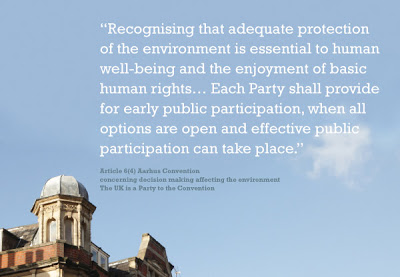
This quote is from the Aarhus Convention, to which the UK is a signatory. It requires early public consultation on environmental issues - like housing, green spaces, heritage buildings and air pollution - "when all options are open and effective public participation can take place" . Hackney says that that is what the Dalston Conversation is offering - but only time will tell.

Sunday, 13 December 2015

Hackney to sell Dalston's "Cultural Quarter"

Hackney has resolved to sell four of its central Dalston sites as one "comprehensive development/ refurbishment package" for "regeneration".  Hackney's Cabinet reached its decision on 23 November without any prior public consultation.


The four sites, to be marketed as the "Dalston Quarter", include the Council's land on part of the Eastern Curve Garden, the former Railway Tavern and the 1865 houses on Ashwin Street, the former CLR James library and the last surviving 1790 Georgian Houses on Dalston Lane.


Hackney owns the entrance land of the hugely popular Eastern Curve Garden. The Kingsland Shopping Centre owns the remainder of the land. The Garden, within Site 1, would be unlikely to survive as we know it if  part were to be developed in a way which compromised present uses.

Although some of the sites are vacant, following demolitions, a number include historic buildings. The Council report states that "buildings with heritage significance will be cherished" but it also reminds of its duty to obtain "best consideration."


Hackney is presently converting the former Railway Tavern,within Site 1, into flats and is marketing the ground floor and basement for commercial uses


V22 Gallery presently occupy these three houses, within Site 1, at 10-16 Ashwin Street for exhibitions and artists' studios

Many of the buildings are occupied by social and cultural enterprises which will be directly affected by the Council's plans for a "comprehensive development/ refurbishment package" . Tenants are often required to give up possession to enable "refurbishment" to proceed. Hackney's report states that the cluster of businesses are "major assets to the character of the town centre" but has also not ruled out private residential development


The last surviving 1790 Georgian houses, within Site 3 at 16-22  Dalston Lane, are occupied in part by Hackney Co-Operative developments and the Farm Shop


The former CLR James library is part of the Council plan. It is part of Site 3 and is presently occupied by Hackney Community Voluntary Services

For three years, since the leaked report "Dalston's heritage under threat", OPEN has been pressing for an extension of Dalston Lane (West) Conservation Area. Although Hackney plan to designate a seperate new Conservation Area covering the High Street, it has done virtually nothing so far to give these town centre buildings heritage protection. Its reasons for delay remain questionable.


Although the Council's "vision" is for a "vibrant exciting quarter"  with "spill out places" and "pedestrian meandering"  (That's enough estate agency waffle. Ed.) it is clear that the existing businesses and diversity already within the area could be at serious risk from the "comprehensive" treatment of all 4 sites, as a single package, which the Council is planning.

Sunday, 9 October 2016

If you love Dalston's character then now's your chance to say so

If you love Dalston's architectural and historic character you have until 31 October to make you views known. Hackney Council's is consulting on long awaited plans to extend the Dalston Lane (West) Conservation Area [DL(W)CA]. Extending the conservation area will give the Council planners wider control to ensure that changes to the local environment preserve and enhance the area's character  - for example changes affecting its buildings (by demolition or alteration), its public and private open spaces, its gardens and trees (which are affected by overshadowing), its road layouts and surfaces (which also affect air quality) and other important features in our environment.
  

This map shows Hackney's existing DL(W)CA outlined in blue and the proposed extension of it outlined in red. The extension includes many of the historic buildings and streets to the north and west. It highlights in red and yellow the buildings which are already 'listed' and, in pink, the buildings which it considers are of 'townscape merit' importance. It highlights in green 'important trees and green spaces'. 

Do you think anything has been missed out? Your views will count. You can make your comments using Hackney's consultation leaflet here or by making comments online here. We hope you'll tell the Council if you support its proposals - but don't forget to also tell them about anything else which you think deserves protection and should be included. 


The Eastern Curve Garden  is not shown as an "important green space" on the Council's DL(W) CA map although the appraisal describes it as an "ever-changing community space, where plants, trees and grass contribute to a diverse ecology". Although the Garden's land, and the Peace Mural, will be within the extended DL(W)CA, the use of the Garden's land itself is presently planned by Hackney for re-development as a "shopping circuit" . 


The former CLR James library dates from 1957-9 and was designed by architects Burley and Moore. It is described as a "redevelopment site" ie one for demolition and redevelopment, and is one of the Dalston "Cultural Quarter" sites which Hackney plans to sell


Four locally listed Georgian properties, at Nos. 16-18 and 20-22 Dalston Lane, have survived re-development to date. They will be within the extended DL(W)CA  but are also part of the Dalston "Cultural Quarter" sites which Hackney plans to sell


For a fascinating account of  Dalston's historical development, and why certain buildings, places and views are considered of conservation value, you can read Hackney's appraisal of the proposed conservation area extension here researched and written by an independent heritage consultant, the erudite Dr Ann Robey. 

The last surviving Georgian houses of the Dalston Lane terrace, which the original DL(W)CA conservation area was designed to protect, are no longer shown as buildings of townscape merit on the Council's new DL(W)CA map. Hackney has already given permission to demolish everything and just rebuild  skin-deep facades in "heritage likeness" -  they describe it as a "genuine conservation led regeneration" ( Genuine? Ed.)


OPEN Dalston members have campaigned long and hard to preserve local character and identity. So much has already been lost to redevelopment.

Conservation Area status has not always prevented neglect and development vandalism but finally, it seems, the Council is recognising Dalston's unique value by extending the Dalston Lane (West) Conservation Area.  (Better late than never! Ed.)