The speech of Lord Low of Dalston,
Patron of OPEN, in a House of Lords debate on Thursday 27 March 2008
The debate
"To call attention to the case for encouraging high-quality architecture in the UK and for ensuring that design quality is taken into account by local Planning Authorities; and to move for papers"
(Lord Howarth of Newport)
Lord Low
"My Lords, in my maiden speech in this chamber I expressed the hope that we might have an opportunity of discussing issues of planning and housing in London before too long, and so I am particularly grateful to the Noble Lord, Lord Howarth, for giving us this opportunity today. It is certainly badly needed. For what we are talking about goes right to the heart of the lives that people lead and the legacy we leave to future generations. As the RIBA (Royal Institute of British Architects) has said: "Design is about much more than aesthetics. It is functional, sustainable and gives pleasure. It attracts people, investment and activity to places, and brings social, environmental and health benefits."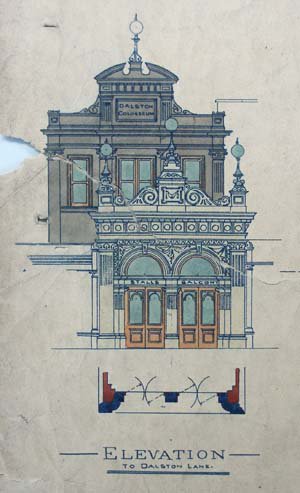 1898 architect's design for the new theatre entrance, built forwards from the original 1886 circus entrance, at North London Colloseum and Amphitheatre, 12 Dalston Lane, London E8.
But of course what is needed is not just a debate. As the RIBA go on to say, design should be one of the most important considerations in new development, and the Planning Bill should be used to entrench design into the planning process. There should be a statutory duty to consider the design quality of planning applications, and local authorities should be encouraged to establish local design review panels or appoint local design champions. I would support this, so long as the local community was represented and not just the "experts".
Both the Barker and Calcutt Reviews endorsed RIBA's recommendations, and it would be good to hear an assurance from the Minister today that the Government will take these forward. But it is not just a matter of institutional reform. There needs to be a sea-change in the culture surrounding the planning process, away from one dominated by the values of hard-faced accountants to one concerned more with quality of life and user involvement.
In my maiden speech, I hinted at the baleful influence of the planning policies of the London Borough of Hackney on the lives of the residents of Dalston, where I live. The protocol surrounding maiden speeches precluded my going into greater detail on that occasion, but today I am under no such constraint.
If I may, therefore, I shall describe for your Lordships our experience in Dalston, as I believe it throws into sharp relief much of what is wrong with development today and what accordingly needs to be put right. Let me straightaway declare an interest as a Patron of OPEN, a not-for-profit company of local individuals and businesses committed to promoting excellence in the quality of the built environment.
When we heard that Dalston was to be regenerated, we had high hopes that this derelict, neglected and overcrowded area of East London would rise as a modern phoenix. We anticipated that our few remaining historic buildings would be given a new lease of life and inform the proposed development around them. How naíve we were. Dalston's historic buildings - despite 30 years of Hackney Council ownership the buildings had survived: the pair of 1820's Georgian houses, the original 1886 circus entrance, the 1898 new Theatre entrance in front of it (which became the Club Four Aces) and Dalston Theatre behind.
"There is absolutely no doubt, based on my experience, that (these buildings) can be satisfactorily brought back to a situation where they can be reused. My experience suggests that repair will not be excessively expensive." Brian A Morton MBE C.Eng MICE Dip Conservation(AA) IHBC Structural Engineer to Canterbury and Bury St Edmunds Cathedrals and the Spitalfields Trust
My Lords, the proposed development consists of two adjoining sites. The driver of the whole project is a site owned by TfL (Transport for London)who are building a new transport hub said to be vital for the Olympics. But there is no direct link to the Olympic site. Had it been 300 yards further on at Dalston Kingsland it would have linked directly to Stratford as well as being much closer to the commercial heart of Dalston. When we protested about this to the London Development Agency, their reply was that this was by no means the only transport hub which was mislocated in this way.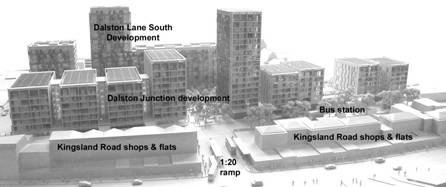 A massively expensive concrete slab over the railway will accommodate an unnecessary and potentially dangerous bus stand, where current routes will be cut short. TfL deployed a kind of circular argument: the bus stand is necessary to enhance the scheme and the scheme is necessary to finance the bus stand. A brutal phalanx of tower blocks of up to twenty storeys will be erected on the slab to help pay for it. These will blight the environment and bring no benefit to the area.
 Of their 300-odd dwellings, none is to be affordable. This is in direct contravention of the Government's policy as affirmed both in this House and in another place. But when we asked the Secretary of State to use her powers to review the scheme, we were simply told that the transport hub was essential of the Olympics.
The adjoining site is being developed by the LDA (London Development Agency). It has similar disadvantages, and moreover is aesthetically and architecturally unrelated to its neighbour. Together they represent the worst type of unimaginative and destructive town planning. No more health and other services are to be provided for the 550 extra households in total. Such high density in an already over-crowded and under-resourced area completely ignores the potential for alienation, anti-social behaviour and vandalism. As a criminologist I know that this is not the way to build a housing estate.
The two sites are separated by a strip of land overshadowed by the tower blocks creating a sunless wind-tunnel. This is the public space the inhabitants of Dalston will have to make the best of for their leisure.
Both schemes will be divorced from proposed developments on the other side of the road in a kind of piecemeal development which lacks any kind of coherence. Instead of design-led regeneration, we have the prospect of a sink estate in less than a generation.
My Lords, how has the travesty I have described come about? Three reasons immediately come to mind: The first is a poor understanding of what constitutes good architecture and design on the part of town planners and developers. High quality architecture and good design do not just consist of buildings. Buildings have context. Good design should blend with and seek to preserve the best of what exists already. That is why the residents of Dalston were so concerned to preserve what little was left of their historic heritage
 How they could have been - restored as part of a new housing and railway station development
"These buildings represent the heart and soul of Dalston. We believe they represent both the past and the future of Dalston’s prosperity. We want to see them restored so that we can show our grandchildren how Dalston used to be and so they can share our pride in our heritage and identity." Ridley Road Market Traders Association
The irony of a blind man lecturing you about architecture will not be lost on your Lordships. But I would say that good design appeals to all the senses. As a native of Edinburgh, I know about well-planned squares and streets, gardens and open spaces. In other countries, they manage these things better: some of your Lordships may, for example, be familiar with Montpellier in France, a city which has preserved its historic area yet has a modern quarter with a unified design, decent public space, trees and water features. You may say that they have more space in France, but even tightly packed New York has small pocket parks for the refreshment and enjoyment of its citizens.
Second, consultation with the public was, to say the least, inadequate, even misleading. Nevertheless, local residents mounted vigorous opposition to the destruction of their heritage and the imposition of unlovely and unsuitable developments wholly out of character with the area.
 Their case was comprehensively ignored.
 The historic buildings were demolished and a modern Gormenghast will rise in their place.
 "We are championing the historic environment and using the Borough’s heritage as a key component of economic regeneration... " Hackney Council, September 2005
This was said to be a once in a lifetime opportunity for Dalston. Instead we are offered off-the-shelf, unimaginatively designed blocks of varying height, with no relationship either to the Victorian street pattern or to each other and with little aesthetic coherence.
And this is the third reason: in direct contravention of planning guidance, these schemes have not preserved heritage buildings or enhanced the cityscape which remains. They meet neither of the Mayor's much-vaunted criteria that new housing should be built to the highest architectural standards and be 50 % affordable. The Council has waived social housing requirements, parking and space standards. The windows of inhabited bedrooms in adjoining blocks will be just five metres apart. Hackney's official standard is twenty-one. In order to fund TfL's bus stand the Council has also leased its site to developers on terms so unfavourable that they required the Secretary of State's consent. The Secretary of State refused to withhold her consent.
Why should all this be? The answer lies partly in the need to meet external and undisclosed financial imperatives out of a misplaced fear that developers would otherwise walk away; partly in developers' ability to hoodwink poorly qualified planning officers into accepting substandard designs; and partly in the ability of multiple authorities in central and local government to evade responsibility with a cynicism which borders on the corrupt. My Lords, in a country of historically renowned architects and with present-day architects who are changing the face of the world, surely we can do better in our own back yard."
The full House of Lords debate can be read here
A 10 year plan to destroy 185 years of history. Read a brief history here: "The story that was never told"

Thursday, 27 March 2008
"It goes right to the heart of the lives that people lead and the legacy we leave to future generations."


Tuesday, 11 March 2008
Hackney bean-counters go bananas in Dalston's market
As a place to buy affordable fresh food and other goods Dalston's Ridley Road market is hard to beat. Competition from the 'loss leaders' offered by Sainsbury and the new local Tesco Metro, keep the traders on their toes. They're up at all hours, rain and shine, working hard to earn an honest living and provide a service to all sections of our diverse community. But it's not just Dalston's best kept secret. People come from far and wide to get a bargain, to join in the fun and to buy what they can't find elsewhere.
But Hackney Council has been prosecuting a number of Ridley's market traders. They had to appear in Thames Magistrates Court on 7th March. One, Mrs Janet Devers, elected to go for a jury trial in the Crown Court. The charges are that she offered fresh vegetables in pounds and ounces, not kilos, and that she sold unweighed produce by the bowl or the bunch. Three other traders faced similar charges but they pleaded guilty and were ordered to pay fines and costs of £615 each. The Council were claiming its costs totalling £5,700 from them.

Janet Devers in Ridley Road market and, below, Janet's mother who was also a market trader from the age of 17.

You may have followed the story about Dalston's "metric martyrs" in the national papers and you can read more about it here. The traders argue that their customers are happy to buy by the bowl or the bunch because "what you see is what you get". But Hackney Council say this gives the traders an "unfair competitive advantage" - although it has produced no evidence of any complaints by customers or other traders to back this up. Janet Devers said "Although the supermarkets charge 79p for a pepper, we charge £1 for a bowlful. It's great value but Hackney say we have to show the number of items in the bowl. Try doing that with every bowl of little hot chillis or grapes".
Fresh produce is sold by the bowl or the bunch in markets all over London without complaint. So why is the latest rash of criminal prosecutions only facing our local market traders? Why are the Council bean-counters going bananas in Ridley?
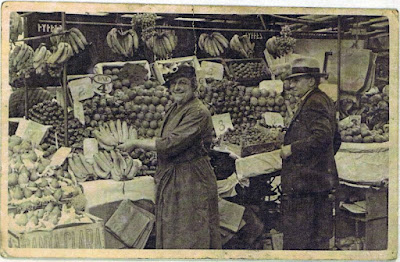
Larry Julian is the Chairman of the Ridley Road Market Traders Association. Larry's family, and many other Dalston families, have been been trading in Ridley market for four generations. They know a thing or two about making a successful market.
 Above, Larry's parents and brother in Ridley Road in 1952 and, below, his grandfather in Ridley market in the late 1940's.
Larry said "The Council is just not listening and it's not helping the market. There were 40 empty stalls last Christmas - it unheard of. Traders feel we're being driven out of the market. People say the Council just has its eyes on the land for development"
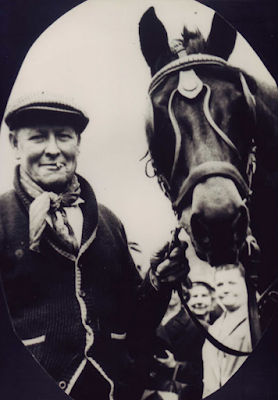
 George Mayo was the last trader to bring produce to Ridley by horse and cart. These photos (above) are of George's parents. George was told that his mother worked so hard that he was actually born on the market stall. Below is George with his daughter Lee, who also trades in Ridley, and their latest horsepower. George's grandson is also a Ridley trader.
One of the problems facing traders arose in 2000 when the food store at 3-4 Birkbeck Road was vandalised and set fire to. It has remained unrepaired, and virtually unusable, ever since despite the traders offering the Council to meet the costs of refurbishment themselves. Another problem concerns the yard at 7 Birkbeck Road. It provides storage for non-perishables and the market barrows. The Council has refused to accept further rents from the traders for the use of these Birkbeck Road sites, it has denied their tenancies and has demanded possession. Without these essential facilities where can traders store goods and barrows when they have to be cleared from the market every night?
The Council's explanation for withdrawing from negotiations for new leases of the two Birkbeck Road sites was that "the Council's internal policy and procedure has changed... with public consultation, the creation and completion of the Dalston Area Action Plan, the Council is investigating its options for regeneration of the market area..." So - nothing to do then with a consultants' recommendation that "LBH may wish to give consideration to alternative use of this (Birkbeck Road) area of land possibly for residential development…"?
The traders obtained a copy of the consultant's report, commissioned by the Council, the day after it told them that there were no plans for the market. The consultants also advised that "in many local authorities, markets have been seen as 'cash cows' providing a very significant revenue". In other words they recommended that the Council should raise the rents and run the market for a profit - although that would mean higher prices for customers which many in Dalston can not afford. And, despite the astonishing £430,000 charged each year to the Markets Account for refuse collection, the consultants said "This is probably the worst market environment we have ever experienced in over 30 years... it's positively third world".

Just recently the Council has issued letters to some 20 traders advising that it will be recommending non-renewal of their licences. A special "Council officers only" Licensing Panel has been set up to hear their appeals. Elected Councillors will play no part, in contrast with alcohol licensing where it is only Councillors who make the decisions. And although it was said that the Licensing Panel would be "independent", in fact the Council's Head of Markets sits on the Panel. Market traders have always had the right to appear and make their appeals in person to the decision makers. But the Council's letters initially told traders that their appeals could only be in writing and that, if they attended the hearing, they could only speak to answer questions put to them. Nor are they entitled to be represented. What other forum in society could dispose of a person's livelihood in such an summary fashion? One hopes that the traders' demands for a fair trial will see the procedures changed.
If traders troubles were not already enough, the Council after "consultation", has now painted double yellow lines all down Ridley market. Any trader taking more than 15 minutes to unload his or her van, or load up at the end of the day, faces a parking fine. This on top of paying the annual £495 business parking charges (in the hope of finding a vacant bay) and the £21.00 per week increase in electricity charges just imposed.
At the recent Dalston 4 London conference everyone agreed that Ridley Market is at the hub of Dalston Town Centre. It's a place where specialist food from all over the world is presently affordable - whether you want to make curry goat, African yam or English apple pie. It's where people of all races and backgrounds are united in a common purpose. This diversity is what makes Ridely - and Dalston - unique, vibrant, attractive and sustainable. But there is something seriously wrong going down in Ridley. Behind their good humour and charm many traders are severely demoralised. Despite the talk of regenerating the market they fear the opposite is planned. Instead of consultation and partnership with the traders, one sees a "top-down" and punitive approach to problem solving. Many traders' livelihoods, and a great community resource, are at stake. The supermarkets will be pleased.
Monday, 10 March 2008

Wednesday, 6 February 2008
Mammon's In My Back Yard #mimby
Our local planning authority says that it is the champion of our heritage. So it wouldn't be frightened and feel bullied into letting developers get their own way. Would they?

The Worship of Mammon 1909 by Evelyn de Morgan
“mammon”: (noun) possibly of Aramaic origin, meaning riches. First personified in English as the false god of wealth, avarice and injustice in the mediaeval poem Piers Plowman and later as the fallen angel, Lucifer, in Milton's Paradise Lost.
“mammonistic”: (adjective) consumed by the desire for wealth at the expense of beauty, creativity and the human soul.
"mammonists" : (secretive) the dark forces, including Philistines, pursuing material gain by the obliteration of heritage, identity, culture and sunlight in the name of regeneration, best value, necessity and progress.
Friday, 21 December 2007
Another box of tricks from Hackney

Commenting on the new Dalston Junction station TfL had stated as recently as November "We'd ask you very strongly that you'd not refer to it as "the Tube"...You should not describe it as the Tube as it is not the Tube". Regretably the Council's Speaker has been sadly misinformed.
The Council Speaker's misunderstanding about this is not suprising. Before the last Council elections the Labour Party described its ambitions for Dalston as including a "tube". The promotional material for TfL's planning application, for its Dalston Junction towerblock development, also described it as a "tube" station, as this image from March 2006 shows.

GLA Mayor Livingstone's London Development Agency also used the tube logo in the images promoting its planning application, for the Council's neighbouring Dalston Theatre site, to demolish Dalston's historic buildings and redevelop with towerblocks. The Hackney Gazette & the Council's Hackney Today paper were also mislead and even now still refer to the proposed Dalston Junction station as a "tube" station.
But despite what Hackney Council, the GLA, TfL and the LDA have all been claiming for the last 2 years, the new Dalston Junction railway station will not be a tube station. It is an overground line station, just like Dalston Kingsland. It will be part of the Overground not the Underground network. Nor does it go to the City or to the Olympic site.
Even the Council's Deputy Mayor and Chief Whip of the Hackney Labour Party, Luke Akehurst, seems to have believed the spin when he said as recently as July 2007 "A derelict theatre or a tube station, which do you think people in Hackney want more?" Whatever the public might have wanted, Dalston will have neither. Furthermore the demolition of Dalston's historic buildings had nothing to do with funding the new station. Funding for the East London Line Extension to Dalston had already got Government approval in the summer of 2004. Dalston's ELLX railway station was going ahead in any event.
The authorities eventually admitted in OPEN's Court proceedings that the profits, from the demolitions and building towerblock flats for sale on Hackney's site, were in fact to be used to subsidise a £39million bus station on a slab above the new Dalston Junction station. Mayor Livingstone's GLA required Hackney taxpayers, and not London communters, to pay the £19million funding shortfall. No one mentioned that Dalston's heritage buildings were to be sacrificed not to pay for a tube but for a bus station.
However, now that the buildings have been demolished and the dust has settled, TfL has put new promotional material, including local childrens' paintings, up on the hoardings fronting their site.

 So was it a simple error that caused the authorities, including TfL, to describe the East London Line Extension as a tube? Or did they think the public might be prepared to pay a higher price if what we thought we were getting was to be the tube?
The Vandals: an eastern Germanic tribe which earned notoriety by it sacking Rome in the 5th century but which was defeated by the Goths.
Vandalism: the gratuitous anti-social destruction of the environment and artistic creations.
Municipal vandalism: the destruction of our cultural heritage by corporate ignorance, deliberate neglect, deceit, vanity and greed all in the name of progress
Monday, 3 December 2007
Hackney Council demolishes more Georgian houses

This is 60-66 Dalston Lane, part of an 1827 Georgain terrace, as it looked in March 2004 when the new owners, an off-shore company, applied for planning permission to demolish the terrace and build rabbit-hutches.
OPEN called in English Heritage who, in August 2004, advised that:
"this is a strong group that has clear local history, despite the poor condition that detracts from their cohesion. Overall the buldings make a valuable contribution to the area, representing early 19th century development in Hackney, an area that grew considerable in this period....inclusion on the local list or within a Conservation Area would be an appropriate designation and recognition of the buildings significance"
Within one month of that report there was an arson attack and 62-64Dalston Lane were burnt down. Mysteriously, bricks from the flank wall of 60 Dalston Lane, and part of the roof, were later deliberately removed.

OPEN has previously written here about the history
In January 2005 the Dalston Lane (West) Conservaton Area was declared. Councillor Nicholson, Hackney Council's Cabinet member for regeneration, said at the time "We're keen conservation areas are used to bring buildings back into use and create improvements to the built environment."
OPEN has since then been urging the Council to take action to bring them back into use and improve the environment. In November 2006 the Council wrote to local shops about its responsibility for and committment to "preserving Hackney's built heritage". Eventually in September 2007 the Council exercised conservation area powers to make the buildings structurally sound and watertight. But it was too little and too late. They had become struturally unstable - and so the Council has done what the owners had wanted all along. It demolished them.

OPEN has asked the Council what its powers and intentions are to rebuild them. Answer came there none.
Wednesday, 3 October 2007
Livingstone's tall storeys railroad Dalston

Although the ELLX is a significant investment in Hackney's transport infrastructure it will not, despite the claims made, be part of the London Underground tube network. It is an overground line. Nor will the ELLX restore Dalston's direct rail link to the City which closed in 1986. Nor does it run to the 2012 Olympic site at Stratford. The ELLX stations in Hackney will not be tube stations.
Our local MPs, Councillors and others have been campaigning for years, if not decades, to connect Hackney to the London Underground tube network. The tube was what would finally put Hackney on the map. It is also seen as an essential element to regenerate an impoverised area. Whoever secured delivery of the tube in Hackney would be triumphant.
But what if the agencies of Mayor Livingstone's Greater London Authority (GLA), with the cooperation of local politicians, could credibly present the ELLX as the arrival in Hackney of the tube? Who knows what price the public might be prepared to pay for such a prize and what rewards might be had by the authorities and local officials.
This promotional image of the authorities plans for Dalston shows that they are guilty of a misrepresentation - Dalston Junction will not be a tube station. Sadly there are many more misrepresentations that have enabled officialdom to destroy historic Dalston, to betray their promises of affordable housing, to dispose for a peppercorn of public land worth £millions and to blight the local, and the wider, environment by gross and profligate overdevelopment.
The planning permission and funding for the ELLX was already in place when TfL had the thought to construct a massive concrete slab spanning over the new railway station. TfL had identified the need to create a bus "turnaround" where some existing, and some new, bus routes from the north would terminate in Dalston and where passengers could interchange with the ELLX rail link. This would reduce bus miles and road congestion into the City. There was nowhere else, TfL said, to put the turnaround and so it is to be built on a concrete slab on top of the new railway station. The estimates for the cost of slab have risen to £39 million. At some £2.5 million per bus stand, and with a 15,000 tonnes carbon footprint, the slab will provide the most expensive bus turnaround in history.
The £39 million cost to build the slab is to be subsidised by £10 million from the government and £10 million from TfL. It is the £19 million funding shortfall that has determined the form of development to be undertake on TfL's site and on Hackney Council's neighbouring site.
The authorities planned to boost the sale value of their sites by first obtaining planning permission for "high revenue generating development". In TfL's case this meant residential tower blocks of up to 20 storeys with 309 private flats for sale, shops and commercial uses. But despite the £39 million public subsidy, and the authorities policies that 50% of new housing developments should be affordable, there is presently to be no public or affordable housing at all on the TfL site.
The development was promoted by TfL and the London Development Agency (LDA) as “regeneration” inspired – “to create a critical mass of people with higher incomes” (Drivers Jonas) with “12 trains an hour to the City” (TfL) and an intention to attract national retailers. It was claimed that the development will bring prosperity for local people. Dalston would become a shopping destination. Each of the new housholds would spend £488 per week in the local area. These claims invite scepticism but undoubtably some people will become more prosperous as a result of this development. Dalston artists have decorated TfL's image of the development.

TfL claimed that the development would be "beneficial in terms of landscape quality and visual impact", however the Council's own report described TfLs's buildings as “austere” and its proposed 20 storey skyscraper as “a stark concrete tower with punched openings for windows”. TfLs environmental consultants described how there will be 80 concrete lorries arriving every day for weeks in Dalston and how “during construction overshadowing and sunlighting losses will begin to occur as the development progresses”.
OPEN, the Kingsland Conservation Area Advisory Committee, the De Beauvoir Association and many local residents objected to TfL's planning application at the time. The objections were to the mass and density of the development, the degraded design standards, the absence of any affordable housing, the loss of human scale to the environment, the profligate use of financial and natural resources and the inadequacy of the planned "open space". To some TfLs proposal appeared to be purely profit-led with scant regard to its environmental context - the crude imposition of a transport-hub to benefit TfL's business but which blights Dalston. To others it seemed to create a buy-to-let opportunity for absentee landlords which would result in families on housing benefit, with children, living up to the 20th floor on short-term tenacies - the re-building of the now demolished high-rise slums of old Holly Street estate. However our local elected politicians decribed it as progress, to bring the 21st century to Dalston, and the Hackney Council's Planning Committee granted TfL permission for the development in March 2006.

TfL had told OPEN that there were no implications for Dalston's heritage architecture arising from its proposals. By that time, with the ELLX plans in place, it had already quietly demolished the original 1865 Dalston Junction station buildings.
The hoardings have now been extended along Dalston Lane and further demolitions are planned and imminent - 2a Dalston Lane, with its decorative wall, curved glass windows and interior period detailing is next to go along with the Victorian house next door.

The Victorian cottages in Roseberry Place have also it seems finally been purchased and now boarded up, soon to be demolished to create space to perhaps squeeze another block of flats onto TfL's site.

A further demolition is planned of 570-572 Kingsland Road (Oxfam) to enable some 50 buses an hour to have ramped access from the turnaround on the slab, across the pavement, into the oncoming traffic of Kingsland Road. Its loss will leave a gap between the listed Georgian terraced buildings of Kingsland Conservation Area - "particularly harmful to the setting of the listed buildings which directly abut the break" (Hackney Council)
The "air rights" to build on TfL's slab, have been offered to the major volume house-builder, Barratt. There is a recent local example of a Barratt development neighbouring Hackney's Town Hall square, on the strategic Richmond Road/Mare Street junction, which has been the subject of some controversy.
 The Council, as local planning authority, are responsibile for ensuring that Barratt will build in accordance with the approved detailed designs and materials. The head of Design for London("DfL"), Peter Bishop, has informed OPEN that DfL will also use its influence to ensure a quality outcome.
At the time when the TfL scheme obtained planning approval, in March 2006, Hackney Council was developing a scheme for its neighbouring site on which stood historic buildings comprising a unique 1886 circus entrance, Dalston Theatre and two locally listed Georgian houses (their history is described here). In Spring 2005 TfL had already drawn up, at the Council's request, a masterplan for both sites in which Dalston's historic buildings had been replaced. In July 2005 the Council's members had been presented with a Planning Brief for the sites to which agreement was essential, it was said, "to ensure the delivery of the East London Line Project...failure to agree the brief will impact on the delivery of the station by 2010". Any threat to Dalston's "tube" was politically unacceptable. Councillors were required to approve "maximising the development potential" of both sites which were considered suitable for tall buildings to a "maximum of 12-15 storeys" with a target of "50% affordable housing". Although the Brief referred to the possibility of demolition, a seperate report referred to the Council's commitment to demolition.
The Brief stated that the two developments would be"complementary" but the plans for the Council's and TfL's developments were not presented side-by-side during the public consultation until an OPEN public meeting in November 2005. There was uproar when the architects drawings were produced.

Dalston Lane's historic buildings were now on the footprint of a proposed 20 storey tower block. They were, in effect, on death row awaiting demolition. The Council made a planning application to itself and, in the face of objections and demonstrations at the Town Hall by the local community, its Planning Committee voted in February 2006 to demolish all the historic buildings.
Many in the community also supported campaigners who took direct action to protect the buildings by occupation
The decision to proceed with demolitions was not however to be taken by our elected policitians but, once again, by a few Council officials. In March the Council's Chief Executive identified a situation of "extreme urgency" to justify authorising funds for implementing the demolition contract (the costs of which were to be reimbursed by the LDA).
The community's awareness and objections to the plans were growing. TfL announced in June that, in the light of the consultation "TfL will meet the costs of the rail station and the bus station" and that the development plans had been modified - the overall density of the two sites had been reduced from 800 to less than 600 flats. The density of the Council's scheme was now for 244 flats, in blocks of up to 20 storeys. But of the 550 flats to be built on both sites only 58, and not 50%, were to be affordable. The rest are, presently, all planned for sale.

The LDA produced a model of the two schemes and in March 2006 made an application to the Council for planning permission to demolish all the buildings on the Council's site and build towerblocks. Despite overwhelming objections from the community the application was granted by the Council's Planning Committee in July 2006.
The purpose of constructing a massive concrete slab over the new ELLX Dalston Junction station is to provide a bus turnaround to benefit TfL's business and London wide commuters. However evidence emerged that the £19 million shortfall on the cost of TfL's slab is not to be met by the Greater London Authority(GLA), nor by its agencies TfL and the LDA, but by Hackney Council's taxpayers. The most money to be made would be from a flattened Council site with permission for a high-rise high-density development with the bare minimum of affordable housing. This is what TfL and the LDA required and what Hackney Council agreed to and has now delivered. It remains to include the Council's site in the LDA's deal with Barrat, the proposed developer of both sites. In return for the disposal of a 125 year lease of its site the Council will get only four empty floors of a towerblock (for a new library)from the developer and the true market value of the site will be used to subsidise the GLA's slab.(See here- Greater London Authority mugs Hackney. Dalston blighted).
Whilst TfL had informed OPEN that it's scheme had no heritage implications, the reverse in fact was true - the demolition of Dalston's historic buildings was a key to subsisiding TfL's slab. As the LDA was to inform the High Court in September 2006 "the development is not possible without demolition...the LDA would have insufficient funds..to fund the slab shortfall of £19 million... failure to undertake the demolition will lead to the abandonment of the existing proposals for the Dalston Project...the opportunity to build the slab will be missed".
The Secretary of State was asked to consider the schemes and decided on 9th November 2006 that "any loss of [Dalston's historic buildings]..can not be given particular weight...noted the design of the proposed buildings and the level of affordable housing.....has concluded that there is not sufficient conflict with national planning policies, or any sufficient reason, to warrant calling in the application.."
Since December 2005 OPEN had obtained a series of injunctions in the High Court to restrain the Council from demolishing the buildings whilst seeking to persuade the authorities to reconsider and retain something of Dalston's history and character. The Council acknowledged that it had never considered whether the historic buildings could be retained as part of the plans. OPEN's application for judicial review finally came before a Judge on 29 November 2006. The Judge found that the Council has a very wide discretion in dealing with its property - it was entitled to depart from its policies aimed to protect historic buildings and need not consider an alternative scheme for the site to incorporate them, or even asses their viability for re-use, particularly where there was an approved redevelopment scheme in existance. The way was clear for the demolitions and these began in February 2007 - the links below tell the story.
The destruction of Dalston Theatre has begun
Hackney destroys its local listed buildings
Municipal vandals have destroyed our children's heritage
How it was - despite the years of deliberate neglect by Hackney Council, the buildings had survived: the pair of 1820's Georgian houses, the original 1886 circus entrance, the 1898 Theatre Entrance in front of it (aka The Four Aces Club) and the Dalston Theatre behind.
"There is absolutely no doubt, based on my experience, that (these buildings)can be satisfactorily brought back to a situation where they can be reused. My experience suggests that repair will not be excessively expensive."
Brian A Morton MBE C.Eng MICE Dip Conservation(AA) IHBC Structural Engineer to Canterbury and Bury St Edmunds Cathedrals and the Spitalfields Trust
How it could have been - restored as part of a new housing and railway station development.
"[These buildings] represent the heart and soul of Dalston. We believe they represent both the past and the future of Dalston’s prosperity. We want to see them restored so that we can show our grandchildren how Dalston used to be and so they can share our pride in our heritage and identity."
Ridley Road Market Traders Association
How it is today - destroyed by Hackney Council with the approval and agreement of Transport for London, the London Development Agency, the Greater London Authority and the Secretary of State.
The Vandals: an eastern Germanic tribe which earned notoriety by it sacking Rome in the 5th century but which was defeated by the Goths.
Vandalism: the gratuitous anti-social destruction of the environment and artistic creations.
Municipal vandalism: the destruction of our cultural heritage by corporate ignorance, deliberate neglect, vanity and greed all in the name of progress