Pages

Wednesday, 25 June 2008

The Four Aces Club - a legacy in the dust

click image to enlarge

For over thirty years Dalston resident Newton Dunbar ran The Four Aces Club . The Club started its life in 1966 at 12 Dalston Lane in the entrance halls of the original 1886 Dalston circus and theatre buildings. It became north London's home of international black music and a second home to black musicians. With increasing success in the 1980s Newton expanded the business, as the Labrynth, which regularly packed out the whole of Dalston Theatre. At weekends Dalston Lane was heaving until the early hours.

Filmaker Winstan Whitter grew up in Dalston and his brilliant documentary film, containing historic footage, about The Four Aces is now out. You can visit here to watch the film's trailer and learn more about the history of the club and its relationship with the police and the Council.


The film will be shown on Sunday 6 July at 1pm as part of the V&A's Motown Weekender. More details here


Winstan (centre) at an OPEN Dalston community day

Winstan campaigned with OPEN to save something of Dalston's history and cultural diversity. The historic buildings were landmarks in our lives and in the lives of previous generations. But despite providing popular entertainment for over 100 years the Council said the buildings had no historic value. Despite a petition with 25,000 signatures roofs were removed, The Four Aces Club was evicted and the buildings were left on death row to become derelict and blight the environment. Sadly they have now been demolished by the authorities to make way for towerblock flats.


How did it happen? A ten year plan to destroy 185 years of culture.

Read "The story that was never told"

Friday, 13 June 2008

Barratt Barratt Barratt. Going Going .......

More bad news for Dalston about Barratt. And yet more here
But it aint over yet - unless, of course, you're one of the many homeless or living in desperately overcrowded conditions:
".....The upshot is that there is going to be a huge shortfall in the number of new homes being built this year. In 2007, there were 190,000 homes built in England, according to the Home Builders Federation (HBF), a trade body. Estimates suggest that the figure for 2008 will be half that number and a long way short of the government’s target of 140,000 new homes erected every year until 2016..."

Thursday, 12 June 2008

Dalston's towerblock deal is looking wobbly

There is more news this week of the crises hitting the major companies involved in the housebuilding industry. Its shareholders are losing confidence and there is worrying news that Barratt's share price has crashed. Following a deal between the Hackney Council and the Greater London Authority, Barratt has commenced building 550 towerblock flats for sale in Dalston. Although the precise terms of the deal with Barratt are the subject of commercial confidentiality, reports to Hackney Council's Cabinet indicated that Council taxpayers would take some of the financial risk on the project. With the slowdown in the housing market the prospect of the Council getting our money back appears to be diminishing.

Sunday, 1 June 2008

Hackney's Mayor Pipe smears children's laureate

Hackney Mayor Pipe’s public smear of the distinguished local writer and broadcaster Michael Rosen, for criticising the way Dalston is being redeveloped, is symptomatic of the Council’s deafness, even intolerance, of any views but its own. You can read the story here and here.

Mayor Pipe may well feel a warm glow of satisfaction and self-belief as he surveys his multi-million pound Hackney Town Hall Square. But from his offices he also sees the grand old Central Library which has been gutted and regenerated as the £30 million Ocean. Sadly it has since been closed for longer than it has been opened. Perhaps he can now feel proud that the Clissold Leisure Centre, following a £40 million overspend, has finally reopened .

Unfortunately Mayor Pipe has lavished no such care and expense on Dalston. Indeed, to help pay for these £70million “flagship” extravagances our desperate for cash Council auctioned off its once thriving Georgian terraces to absentee landlords, over the heads of its Council lessees. In Dalston we have since witnessed evictions, arson attacks and total dereliction.


OPEN has previously written here about the history. OPEN has campaigned for the compulsory purchase of the houses and for the Council to sell them on with conditions for refurbishment. We are told its Cabinet will finally consider this proposal in July. But the only outcome so far of the Council’s too little, too late “conservation led regeneration” policies has been the costly demolition of three more Georgian houses in Dalston Lane paid for from the public purse. Just what the landlord wanted.


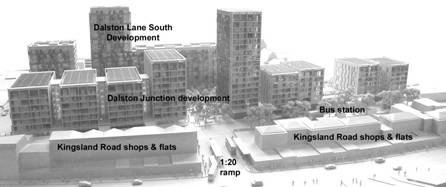
But that is not an isolated example of Hackney’s municipal vandalism. Just up the road at Dalston Junction we had a similar story – the removal of roofs, the eviction of thriving businesses, then years of neglect, dereliction and finally the demolition of Dalston’s historic buildings on Mayor Pipe’s orders. Orders initially given before even planning permission and Cabinet approval had been obtained (see here for the story). Under construction now are the 20-storey towerblocks needed to pay for Transport for London’s new bus turnaround which is to be built above the reopened Dalston Junction overground station.


All in the name of “best value”, “attracting a critical mass of better off people”, “regeneration” and the 2012 Olympics.

Mayor Pipe commented that the choices for Dalston were made “with the best interests of the borough at heart”. Why then are Hackney residents subsidising the £39 million concrete slab needed for Transport for London’s bus turnaround? To sweeten this pill, just before the planning application and the later Mayoral elections, the authorities trumpeted the arrival of “The Tube” for Dalston - which TfL and Mayor Pipe now admit it is not.


The deal which Mayor Pipe and his officers negotiated for Dalston was so unfavourable that he had to obtain the Secretary of State’s approval to dispose of the Council’s site at undervalue.

Had “best value” been obtained we might instead have seen 258 (50%) not 58 new homes affordable to local people; quality buildings of appropriate scale rather than children living up to the 20th storey in towers blotting out the sunlight; some affordable space not just chain stores which take their profits elsewhere and drive up local rents. We might have seen some of Dalston’s character and diverse cultural history retained rather than a cloned shopping mall.

We could have seen local people involved and committed to the change instead, as is so often the case, feeling alienated, powerless and resentful. Michael Rosen’s anger at the authorities’ treatment of Dalston is shared by very many local people of all political, economic, ethnic and social groupings. For Mayor Pipe to describe those who disagree with him, by calling them the “Keep Hackney Crap” brigade, is a crude smear.

Wednesday, 2 April 2008

We are building the slums of the tomorrow

"There is also something seriously wrong when new houses across the country form rootless estates and could just as well be in Beijing, Buenos Aires or Belfast. These are developments which have no regard for a community's sense of place, belonging or identity. I fear we are building the slums of the tomorrow but it shouldn't be. Britain has some of the best architects in the world."

Sir Richard Rogers, Architect & Head of the Government's Urban Task Force, a commission of architects, planners and engineers which produced a blueprint for inner-city renewal that focused on design-led buildings and reform of the planning system to allow greater involvement of residents.
The Independent 29 March 2008


Hackney Council and Greater London Authority's plans for Dalston - now under construction

"Save our past. Save our future.
The developers will not be building the new Jerusalem in Dalston but towerblock flats for sale which will overshadow and blight the area. They may be seen as a buy-to-let opportunity to house a transient population and become the slums of the future. We will see our children living at height with nothing for them except a tiny dark playground at the bottom of the canyon between the skyscrapers. It is a hypocritical betrayal of Dalston’s community, and of hard won Council policies, to condemn future generations to this and wipe out our childrens’ and grandchildren’s heritage into the bargain. We do not want to live in the past, but we do want to live with it."

www.OPENdalston.net 26 July 2006

Thursday, 27 March 2008

"It goes right to the heart of the lives that people lead and the legacy we leave to future generations."


The speech of Lord Low of Dalston,
Patron of OPEN, in a House of Lords debate on Thursday 27 March 2008


The debate
"To call attention to the case for encouraging high-quality architecture in the UK and for ensuring that design quality is taken into account by local Planning Authorities; and to move for papers"
(Lord Howarth of Newport)

Lord Low
"My Lords, in my maiden speech in this chamber I expressed the hope that we might have an opportunity of discussing issues of planning and housing in London before too long, and so I am particularly grateful to the Noble Lord, Lord Howarth, for giving us this opportunity today. It is certainly badly needed. For what we are talking about goes right to the heart of the lives that people lead and the legacy we leave to future generations. As the RIBA (Royal Institute of British Architects) has said: "Design is about much more than aesthetics. It is functional, sustainable and gives pleasure. It attracts people, investment and activity to places, and brings social, environmental and health benefits."
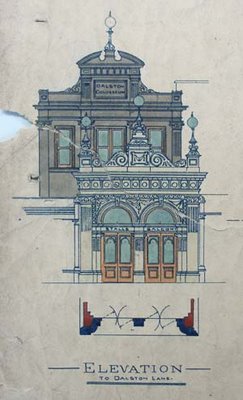
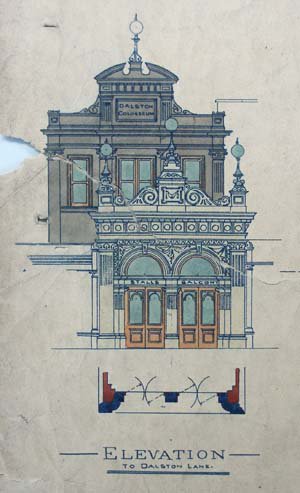
1898 architect's design for the new theatre entrance, built forwards from the original 1886 circus entrance, at North London Colloseum and Amphitheatre, 12 Dalston Lane, London E81898 architect's design for the new theatre entrance, built forwards from the original 1886 circus entrance, at North London Colloseum and Amphitheatre, 12 Dalston Lane, London E8.

But of course what is needed is not just a debate. As the RIBA go on to say, design should be one of the most important considerations in new development, and the Planning Bill should be used to entrench design into the planning process. There should be a statutory duty to consider the design quality of planning applications, and local authorities should be encouraged to establish local design review panels or appoint local design champions. I would support this, so long as the local community was represented and not just the "experts".

Both the Barker and Calcutt Reviews endorsed RIBA's recommendations, and it would be good to hear an assurance from the Minister today that the Government will take these forward. But it is not just a matter of institutional reform. There needs to be a sea-change in the culture surrounding the planning process, away from one dominated by the values of hard-faced accountants to one concerned more with quality of life and user involvement.

In my maiden speech, I hinted at the baleful influence of the planning policies of the London Borough of Hackney on the lives of the residents of Dalston, where I live. The protocol surrounding maiden speeches precluded my going into greater detail on that occasion, but today I am under no such constraint.

If I may, therefore, I shall describe for your Lordships our experience in Dalston, as I believe it throws into sharp relief much of what is wrong with development today and what accordingly needs to be put right.

Let me straightaway declare an interest as a Patron of OPEN, a not-for-profit company of local individuals and businesses committed to promoting excellence in the quality of the built environment.

When we heard that Dalston was to be regenerated, we had high hopes that this derelict, neglected and overcrowded area of East London would rise as a modern phoenix. We anticipated that our few remaining historic buildings would be given a new lease of life and inform the proposed development around them. How naĆ­ve we were.

Dalston's historic buildings - despite 30 years of Hackney Council ownership the buildings had survived: the pair of 1820's Georgian houses, the original 1886 circus entrance, the 1898 new Theatre entrance in front of it (which became the Club Four Aces) and Dalston Theatre behind.

"There is absolutely no doubt, based on my experience, that (these buildings) can be satisfactorily brought back to a situation where they can be reused. My experience suggests that repair will not be excessively expensive." Brian A Morton MBE C.Eng MICE Dip Conservation(AA) IHBC Structural Engineer to Canterbury and Bury St Edmunds Cathedrals and the Spitalfields Trust


My Lords, the proposed development consists of two adjoining sites. The driver of the whole project is a site owned by TfL (Transport for London)who are building a new transport hub said to be vital for the Olympics. But there is no direct link to the Olympic site. Had it been 300 yards further on at Dalston Kingsland it would have linked directly to Stratford as well as being much closer to the commercial heart of Dalston. When we protested about this to the London Development Agency, their reply was that this was by no means the only transport hub which was mislocated in this way.
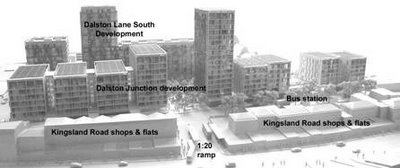
A massively expensive concrete slab over the railway will accommodate an unnecessary and potentially dangerous bus stand, where current routes will be cut short. TfL deployed a kind of circular argument: the bus stand is necessary to enhance the scheme and the scheme is necessary to finance the bus stand. A brutal phalanx of tower blocks of up to twenty storeys will be erected on the slab to help pay for it. These will blight the environment and bring no benefit to the area.

Of their 300-odd dwellings, none is to be affordable. This is in direct contravention of the Government's policy as affirmed both in this House and in another place. But when we asked the Secretary of State to use her powers to review the scheme, we were simply told that the transport hub was essential of the Olympics.

The adjoining site is being developed by the LDA (London Development Agency). It has similar disadvantages, and moreover is aesthetically and architecturally unrelated to its neighbour. Together they represent the worst type of unimaginative and destructive town planning.

No more health and other services are to be provided for the 550 extra households in total. Such high density in an already over-crowded and under-resourced area completely ignores the potential for alienation, anti-social behaviour and vandalism. As a criminologist I know that this is not the way to build a housing estate.

The two sites are separated by a strip of land overshadowed by the tower blocks creating a sunless wind-tunnel. This is the public space the inhabitants of Dalston will have to make the best of for their leisure.


Both schemes will be divorced from proposed developments on the other side of the road in a kind of piecemeal development which lacks any kind of coherence. Instead of design-led regeneration, we have the prospect of a sink estate in less than a generation.

My Lords, how has the travesty I have described come about? Three reasons immediately come to mind: The first is a poor understanding of what constitutes good architecture and design on the part of town planners and developers. High quality architecture and good design do not just consist of buildings. Buildings have context.

Good design should blend with and seek to preserve the best of what exists already. That is why the residents of Dalston were so concerned to preserve what little was left of their historic heritage

How they could have been - restored as part of a new housing and railway station development

"These buildings represent the heart and soul of Dalston. We believe they represent both the past and the future of Dalston’s prosperity. We want to see them restored so that we can show our grandchildren how Dalston used to be and so they can share our pride in our heritage and identity." Ridley Road Market Traders Association


The irony of a blind man lecturing you about architecture will not be lost on your Lordships. But I would say that good design appeals to all the senses. As a native of Edinburgh, I know about well-planned squares and streets, gardens and open spaces. In other countries, they manage these things better: some of your Lordships may, for example, be familiar with Montpellier in France, a city which has preserved its historic area yet has a modern quarter with a unified design, decent public space, trees and water features. You may say that they have more space in France, but even tightly packed New York has small pocket parks for the refreshment and enjoyment of its citizens.

Second, consultation with the public was, to say the least, inadequate, even misleading.

Nevertheless, local residents mounted vigorous opposition to the destruction of their heritage and the imposition of unlovely and unsuitable developments wholly out of character with the area.


Their case was comprehensively ignored.

The historic buildings were demolished and a modern Gormenghast will rise in their place.

"We are championing the historic environment and using the Borough’s heritage as a key component of economic regeneration... " Hackney Council, September 2005

This was said to be a once in a lifetime opportunity for Dalston. Instead we are offered off-the-shelf, unimaginatively designed blocks of varying height, with no relationship either to the Victorian street pattern or to each other and with little aesthetic coherence.

And this is the third reason: in direct contravention of planning guidance, these schemes have not preserved heritage buildings or enhanced the cityscape which remains. They meet neither of the Mayor's much-vaunted criteria that new housing should be built to the highest architectural standards and be 50 % affordable. The Council has waived social housing requirements, parking and space standards. The windows of inhabited bedrooms in adjoining blocks will be just five metres apart. Hackney's official standard is twenty-one.

In order to fund TfL's bus stand the Council has also leased its site to developers on terms so unfavourable that they required the Secretary of State's consent. The Secretary of State refused to withhold her consent.

Why should all this be? The answer lies partly in the need to meet external and undisclosed financial imperatives out of a misplaced fear that developers would otherwise walk away; partly in developers' ability to hoodwink poorly qualified planning officers into accepting substandard designs; and partly in the ability of multiple authorities in central and local government to evade responsibility with a cynicism which borders on the corrupt.

My Lords, in a country of historically renowned architects and with present-day architects who are changing the face of the world, surely we can do better in our own back yard."

The full House of Lords debate can be read here

A 10 year plan to destroy 185 years of history. Read a brief history here: "The story that was never told"

Tuesday, 11 March 2008

Hackney bean-counters go bananas in Dalston's market

As a place to buy affordable fresh food and other goods Dalston's Ridley Road market is hard to beat. Competition from the 'loss leaders' offered by Sainsbury and the new local Tesco Metro, keep the traders on their toes. They're up at all hours, rain and shine, working hard to earn an honest living and provide a service to all sections of our diverse community. But it's not just Dalston's best kept secret. People come from far and wide to get a bargain, to join in the fun and to buy what they can't find elsewhere.

But Hackney Council has been prosecuting a number of Ridley's market traders. They had to appear in Thames Magistrates Court on 7th March. One, Mrs Janet Devers, elected to go for a jury trial in the Crown Court. The charges are that she offered fresh vegetables in pounds and ounces, not kilos, and that she sold unweighed produce by the bowl or the bunch. Three other traders faced similar charges but they pleaded guilty and were ordered to pay fines and costs of £615 each. The Council were claiming its costs totalling £5,700 from them.


Janet Devers in Ridley Road market and, below, Janet's mother who was also a market trader from the age of 17.


You may have followed the story about Dalston's "metric martyrs" in the national papers and you can read more about it here. The traders argue that their customers are happy to buy by the bowl or the bunch because "what you see is what you get". But Hackney Council say this gives the traders an "unfair competitive advantage" - although it has produced no evidence of any complaints by customers or other traders to back this up. Janet Devers said "Although the supermarkets charge 79p for a pepper, we charge £1 for a bowlful. It's great value but Hackney say we have to show the number of items in the bowl. Try doing that with every bowl of little hot chillis or grapes".

Fresh produce is sold by the bowl or the bunch in markets all over London without complaint. So why is the latest rash of criminal prosecutions only facing our local market traders? Why are the Council bean-counters going bananas in Ridley?

When you look behind the newspaper headlines and listen to the traders, you get to see the bigger picture. Hackney has recently recruited extra 'enforcement officers'. But it's not the fly-by-nights and chancers who the Council are coming down hard on. Nor is it just the 'metric martyrs'. The Council's new policies are hitting some of Dalston's oldest family businesses as well as some of the most vulnerable new traders who are struggling for a start in life.

Larry Julian is the Chairman of the Ridley Road Market Traders Association. Larry's family, and many other Dalston families, have been been trading in Ridley market for four generations. They know a thing or two about making a successful market.

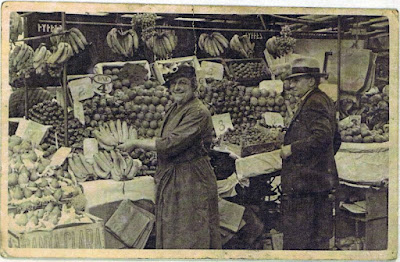
Above, Larry's parents and brother in Ridley Road in 1952 and, below, his grandfather in Ridley market in the late 1940's.


Larry said "The Council is just not listening and it's not helping the market. There were 40 empty stalls last Christmas - it unheard of. Traders feel we're being driven out of the market. People say the Council just has its eyes on the land for development"


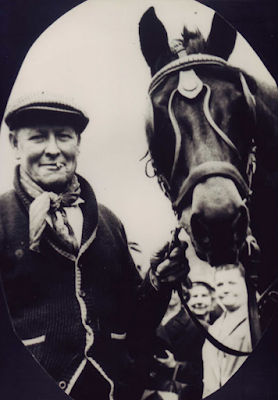
George Mayo was the last trader to bring produce to Ridley by horse and cart. These photos (above) are of George's parents. George was told that his mother worked so hard that he was actually born on the market stall. Below is George with his daughter Lee, who also trades in Ridley, and their latest horsepower. George's grandson is also a Ridley trader.


One of the problems facing traders arose in 2000 when the food store at 3-4 Birkbeck Road was vandalised and set fire to. It has remained unrepaired, and virtually unusable, ever since despite the traders offering the Council to meet the costs of refurbishment themselves. Another problem concerns the yard at 7 Birkbeck Road. It provides storage for non-perishables and the market barrows. The Council has refused to accept further rents from the traders for the use of these Birkbeck Road sites, it has denied their tenancies and has demanded possession. Without these essential facilities where can traders store goods and barrows when they have to be cleared from the market every night?

The Council's explanation for withdrawing from negotiations for new leases of the two Birkbeck Road sites was that "the Council's internal policy and procedure has changed... with public consultation, the creation and completion of the Dalston Area Action Plan, the Council is investigating its options for regeneration of the market area..." So - nothing to do then with a consultants' recommendation that "LBH may wish to give consideration to alternative use of this (Birkbeck Road) area of land possibly for residential development…"?

The traders obtained a copy of the consultant's report, commissioned by the Council, the day after it told them that there were no plans for the market. The consultants also advised that "in many local authorities, markets have been seen as 'cash cows' providing a very significant revenue". In other words they recommended that the Council should raise the rents and run the market for a profit - although that would mean higher prices for customers which many in Dalston can not afford. And, despite the astonishing £430,000 charged each year to the Markets Account for refuse collection, the consultants said "This is probably the worst market environment we have ever experienced in over 30 years... it's positively third world".


Just recently the Council has issued letters to some 20 traders advising that it will be recommending non-renewal of their licences. A special "Council officers only" Licensing Panel has been set up to hear their appeals. Elected Councillors will play no part, in contrast with alcohol licensing where it is only Councillors who make the decisions. And although it was said that the Licensing Panel would be "independent", in fact the Council's Head of Markets sits on the Panel. Market traders have always had the right to appear and make their appeals in person to the decision makers. But the Council's letters initially told traders that their appeals could only be in writing and that, if they attended the hearing, they could only speak to answer questions put to them. Nor are they entitled to be represented. What other forum in society could dispose of a person's livelihood in such an summary fashion? One hopes that the traders' demands for a fair trial will see the procedures changed.

If traders troubles were not already enough, the Council after "consultation", has now painted double yellow lines all down Ridley market. Any trader taking more than 15 minutes to unload his or her van, or load up at the end of the day, faces a parking fine. This on top of paying the annual £495 business parking charges (in the hope of finding a vacant bay) and the £21.00 per week increase in electricity charges just imposed.

At the recent Dalston 4 London conference everyone agreed that Ridley Market is at the hub of Dalston Town Centre. It's a place where specialist food from all over the world is presently affordable - whether you want to make curry goat, African yam or English apple pie. It's where people of all races and backgrounds are united in a common purpose. This diversity is what makes Ridely - and Dalston - unique, vibrant, attractive and sustainable. But there is something seriously wrong going down in Ridley. Behind their good humour and charm many traders are severely demoralised. Despite the talk of regenerating the market they fear the opposite is planned. Instead of consultation and partnership with the traders, one sees a "top-down" and punitive approach to problem solving. Many traders' livelihoods, and a great community resource, are at stake. The supermarkets will be pleased.