Pages

Tuesday, 17 July 2007

Save the Old Souls - will Hanover re-think its plans

To treat tenants like commodities, to be turned out of their homes so that their landlord can capitalise on the site's development potential, is bad enough. But what if the tenants are elderly and in sheltered accommadation, and the land was until recently in community ownership and the landlord is a charitable housing association? This is the situation facing the elderly tenants in sheltered accommodation at Bayton Court on the west side of London Fields, E8.

Bayton Court


Bayton Court is one of 29 sheltered housing schemes which were transferred by Hackney Council to a "formed for purpose" charitable housing association, Hanover in Hackney, in October 2002. At that time it was made clear to tenants that the Council had no money to improve the run-down properties but it was promised that, if the tenants voted to transfer to Hanover, £41 million would be invested and every flat would be refurbished within 5 years and that tenant’s resident wardens and the services provided to them would remain the same. Unsurprisingly a majority of tenants voted in favour.

Beaumont Lodge


In 2003, shortly after the transfer, Hanover undertook a review of its former Council assets and began working on realising opportunities to raise capital by the development and sale of some of its 29 properties. It commissioned architects and in January 2007 made 12 planning applications to the Council which variously involved demolition and redevelopment for private sales as well as alterations to those properties to be retained and refurbished.

Parton Lodge


The specific planning application for Bayton Court is to demolish the 2-storey building of 26x1 bedroom homes and to redevelop the site to provide 16x4-bedroom houses and 2x4-bedroomed maisonettes of up to 4 and 5 storeys for private sale. Quite apart from the need to evict & rehouse the elderly residents, the redevelopment will impact on the residents of neighbouring Blackstone Estate who lodged strong objections with the Council regarding loss of light, increased density and noise, living next to a potential car park, overlooking etc. In addition it will create significant changes to the setting and streetscape of London Fields. Although the redevelopment proposal for Bayton Court does not satisfy the Council’s planning policies Hanover asked that it should be considered “holistically” in the context of the 11 other planning applications made simultaneously. However, taking all planning applications together, they do not satisfy the policies either.

Bayton Court redevelopment - architect's impresion


These plans are however not the sum cause of the elderly tenants anxieties. In March 2006 Hanover advised its tenants that, due to Hackney Council's requirements and government changes to the financing of its “Supporting People” programme (“it is important that efficiency savings are optimised and secured as early as possible” - Government independent review by RSM Robson Rhodes LLP Oct 2003) , it was considering replacing the resident wardens in the sheltered housing with “floating support” workers who would visit only occasionally. But, despite Hanover's "floating support" pilot project and its consultation with tenants remaining incomplete, none of Hanover’s 12 planning applications for redevelopment show existing resident warden’s flats and offices as retained. Hanover has recently announced that this new scheme is likely to be introduced in November 2007.

Keswick Lodge

Unlike the tenant's ballot of 2002, which determined whether the property transfer away from Hackney Council would proceed, Hanover's demolition and redevelopment plans, and the loss of the sheltered housing officers, will not be the subject of a tenants’ ballot. There will be “consultation” with tenants but Hanover will have the final say.

OPEN, in association with the London Fields User Group, organised a meeting at St Michaels and All Angels Church Hall 7th June 2007 which was well attended by local tenants, residents and community representatives. An outline of the schemes was presented by two of Hanover’s representatives, and its architect, and these were met with searching questions and strong criticisms on planning and moral grounds. We learned how £142,000 had recently been spent refurbishing the buildings now intended for demoltion. Hanover stated that Bayton Court had been selected for redevelopment and private sale because it is the most valuable and attractive site which it owns. Apparently too valuable an opportunity to be wasted on sheltered accommodation for the elderly.

OPEN’s solicitors have requested that the Council and Hanover provide a copy of the legal agreement which they reached in 2002 which was said to guarantee that the promises made to elderly tenants at the time of the transfer ballot would be kept. Despite reminders, neither have provided a copy of the agreement.

OPEN has recently been informed by the Council that all Hanover’s planning applications have now been withdrawn. It is expected that revised plans will be re-submitted in due course.

Con” - noun: a complicated confidence trick planned and executed with great care; - verb: to deprive of by deceit; - colloquial: abbreviation of consultation

Friday, 22 June 2007

Councillor Darren Parker suspended

On 20th June Councillor Darren Parker was suspended by the Council’s Standards Sub-Committee from participating in any Council Committees and directed to undertake further training in the "Councillors Code of Conduct". The Sub-committee found that, on Councilor Parker’s own admission, he had breached the Councillor’s Code of Conduct. The suspension is immediate and for a period of three months, which is the maximum period which the Sub-Committee could impose, or until he undertakes the training if earlier.

The breach concerned Councillor Parkers failure in July 2006 to declare a “personal interest”, namely his employment by the Commission for Architecture and the Built Environment (CABE), before Chairing a Committee and using his casting vote to grant planning permission to the London Development Agency (LDA). The permission was for the demolition of historic buildings, including Dalston Theatre and Georgian houses, and building towerblocks. Council officers had relied upon CABEs favourable comments when recommending that the application be granted.

The Standards Sub-Committee stated that it was a difficult decision with finely balanced arguements. It also found that a member of the public, knowing the full facts, would not reasonably regard Cllr Parker’s employment by CABE as so significant that it would have been likely to prejudice his judgment of the public interest and thus have disqualified him from voting.

Councillor Parker had denied that the fact of his employment by CABE had influenced his votes in any way. Following the Committee’s verdict his representative said, in his mitigation, that he had been the victim of a “vicious and highly charged campaign” which sought to “challenge the authority of the Council” and which had affected his relationship with his employer.

Monday, 18 June 2007

The 15,000 tonnes carbon footprint of TfL's Dalston concrete slab

The permission and funding to extend the East London Line to Dalston was already in place and proceeding when TfL proposed rafting over Dalston Junction railway cutting to build a bus station and “transport interchange” on top of it. The dense revenue-generating development of flats for private sale, on both TfL's and Hackney's sites, and the £millions subsidy by Hackney, is driven by the need to fund the estimated £39million costs of the concrete slab. This amounts to over £3million per bus stand.

There will be over 75 concrete lorries arriving in Dalston every day for months once construction starts. Yet the authorities claim that the developments, with “eco-homes”, wind turbines and green roofs on the towerblocks, are “environmentally sustainable”.

OPEN has estimated, with advice from consultants to The Carbon Trust, that the carbon emissions to construct the reinforced concrete slab alone will produce approximately 15,000 tonnes of CO2. This is equivalent to the GLA's electricity bill for the next 12 years or the GLA’s Mayor Ken Livingstone, or Hackney’s Mayor Jules Pipe, flying return to New York continuously for the next 34 years.

This gross waste of financial and natural resources to construct the Dalston slab has been authorised by the GLA's and Hackney’s Mayors. OPEN would regard anything more than a one-way ticket to New York for them as a further extravagance.

Demolition of Dalston’s historic buildings: Darren “One man, two votes” Parker to face Hackney Standards Committee hearing.


An investigation, instigated by the Standards Board for England (SBE), has found that Hackney Councillor, Darren Parker, had a personal and a prejudicial interest when he used his Chair’s casting vote last July to grant planning permission for the demolition of Dalston’s heritage buildings and their replacement with towerblock flats. The investigation has found that Councillor Parker should have withdrawn from and not voted in the meeting. Had he done so the application would have been refused on the balance of votes cast. Hackney’s Standards Sub-Committee is to consider the report’s findings, and Councillor Parker’s representations, and make a ruling on Wednesday 20th June.

The London Development Agency’s (LDA) controversial application, to demolish the heritage buildings and replace them with towerblocks, came before Hackney’s Planning Sub-Committee on 13 July 2006.

How it was - despite the years of deliberate neglect by Hackney Council, the buildings had survived: the pair of 1820's Georgian houses, the original 1886 circus entrance, the 1898 Theatre Entrance in front of it (aka The Four Aces & Labyrinth Clubs) and the Dalston Theatre behind.


"There is absolutely no doubt, based on my experience, that (these buildings)can be satisfactorily brought back to a situation where they can be reused. My experience suggests that repair will not be excessively expensive."
Brian A Morton MBE C.Eng MICE Dip Conservation(AA) IHBC Structural Engineer to Canterbury and Bury St Edmunds Cathedrals and the Spitalfields Trust

The Committee granted permission to the LDA to build 244 towerblock flats of which only 58 (24%) will be affordable housing and which will have children living up to the 20th floor. Profits from the sale of Hackney Council’s site to the developer, Barrat, will be paid to the LDA to subsidise a £39million concrete slab over the neighbouring railway site owned by Transport for London (TfL). TfL’s development will comprise a bus station and more towerblocks of up to 20 storeys but all of the 305 flats proposed there will be for sale with no affordable housing at all.


The proposals met with hundreds of objections from the local community and OPEN obtained 3 High Court injunctions to delay the plans whilst arguing for retaining some of Dalston’s character buildings.

Since November 2005 Councillor Parker had been an employee of the government quango, the Commission for Architecture and the Built Environment (CABE). He was elected to the Council in May 2006 and by the time of the July decision had been appointed Vice-Chair of the Planning Committee. His employer, CABE, was a consultee on the application and Hackney’s officers had relied on its positive opinion of the redevelopment schemes when recommending that the Planning Committee grant the application. A scheme to retain some of the historic buildings was never considered.

How it could have been - restored as part of a new housing and railway station development.


"[These buildings] represent the heart and soul of Dalston. We believe they represent both the past and the future of Dalston’s prosperity. We want to see them restored so that we can show our grandchildren how Dalston used to be and so they can share our pride in our heritage and identity."
Ridley Road Market Traders Association


Hackney had convened a “call over” meeting a week earlier to “discuss the application” with Councillor Parker. The usual Committee Chair had declared a conflict of interest and could not participate in that discussion and the later Planning Committee meeting. Councillor Parker chaired both meetings without declaring any interest. Councillor Parker, who had recently had conflict of interest training, reportedly did not seek prior legal advice but immediately after the second meeting he informed the Council’s Monitoring Officer of his position within CABE. He has subsequently stated to the investigating lawyer “it is clear now that I definitely had a personal interest” but, whilst accepting that he contravened Hackney’s Code of Conduct, he denied that his interest was prejudicial. The lawyer has however found that it would not be unreasonable to assume that he “would not approach the application with an open mind for various reasons including not contradicting the views and wishes of his employers in order not to jeopardise his employment or the likelihood of progressing in his career within the organisation… he should have withdrawn....and not participated”. Darren Parker has since resigned from the Committee.


Councillor Parker had declared his employment on the Council’s Register of Member’s Interests but, despite this, the Council’s Monitoring Officer, the Committee’s Lawyer and the Committee’s Officer all denied advance knowledge of his employment. The Committee Officer stated that had he known he “would have advised him to declare an interest as this case was high profile”. Since then the Register of Interests has been withdrawn from the Council’s web site, although this is reported to be due to genuine technical incompetence rather than because Hackney has something to hide.

The LDAs planning application was considered again in September when some amendments were made to the planning conditions. Commenting on this, Hackney’s Head of Regeneration, Fiona Fletcher-Smith stated in OPENs injunction proceedings that “the minor alterations identified in the report to a (September) planning sub-committee in regards to this application are not felt to affect the principles of the decision previously made on 13 July”. However Hackney has since sought to argue that, because Councillor Parker was not present at the September meeting, any defect in the July permission had been remedied.

Despite knowing that the SBE investigation was underway in September, Hackney’s Mayor ordered the demolition of Dalston’s historic buildings to proceed in December.


Hackney has failed to convene its Standards Committee to consider the allegations until now although the investigation report was completed in March. Its Head of Law, Amanda Kelly, is reported to have denied that there has been any unreasonable delay and has stated that “the planning consent was given for the Dalston Lane development and that consent still stands”.

The demolished and cleared site remains empty because Hackney has been unable to complete its agreement with Barratt since receiving independent legal advice that the disposal of its site, in exchange for a peppercorn rent and a four floor shell to house a library, is "for less than the best consideration that can reasonable be obtained". The Council must therefore obtain government approval for the deal.

All the money which Barratt would otherwise have paid the Council for it's land will be paid to the LDA to subsidise the construction of the £39 million concrete slab for the bus station over TfL's neighbouring Dalston Junction railway station. Barrat will then have the right to build more tower blocks on the slab as part of a residential and retail development

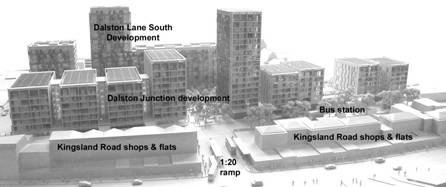
The buildings proposed have been designed to maximise revenue without regard to Dalston's character and streetscape. Viewing TfLs designs, local artists have commented.


<


OPEN had previously asked the Secretary of State to call in the LDAs planning application but this was refused because, it was said, the project would provide essential infrastructure for the Olympics. OPENs Patron, Lord Low of Dalston, also arranged a meeting with the LDA’s Chief Executive, Manny Lewis, but he replied that “..the LDA did not agree to reconsider its redevelopment proposals…it is disadvantageous to revisit the plans”

How it is today - destroyed by Hackney Council with the approval and agreement of Transport for London, the Greater London Authority and the Secretary of State.


We have witnessed municipal vandalism, incompetence, dishonesty and a hypocritical betrayal of Dalston’s community. This scheme is costing Hackney's taxpayers millions. They are not building Jerusalem but Croydonising Dalston with buy-to-let slums of the future. Hackney has sold our grandchildren’s heritage buildings for a peppercorn to subsidise a £39million concrete slab with towerblocks which will blight Dalston.

How did it happen?
Read the posting
"The story that was never told"

Tuesday, 22 May 2007

Greater London Authority mugs Hackney. Dalston blighted.

The demolition and redevelopment deal for New Dalston, brokered between Hackney Council and Ken Livingstone's agencies in May 2005, is shortly to be sealed. All the money from selling the Council's site will be taken by the London Development Agency and dense and poorly designed towerblocks will be built which will dominate the low-rise Victorian streetscape and will blight Dalston's environment.

On 23rd April Hackney Mayor's Cabinet authorised its officers to grant a 125 year lease of the Dalston Lane (South) site and 1-3 Roseberry Place (Boss Shoes factory) to the developer, Barratts, for a peppercorn. In return Hackney will get a shell of 4 floors, for a new library and archive resource, in one of the new tower blocks that will front Dalston Lane. Barratts will contribute £1.2 million "planning gain" money to the fitting out costs which are expected to exceed £2 million.


All the money which Barratts would otherwise pay the Council for it's land will be paid to the GLA's London Development Agency towards the cost of constructing a £39 million concrete slab and bus station over TfL's neighbouring Dalston Junction railway station. Barratts will then have the right to build more tower blocks on the slab.


The Council will only start to recover its £2 million "set up" costs for the development, which include the demolition costs of Dalston's historic buildings which were on the site, if the receipts from the sale of Barratts 525 towerblock flats exceed £154 million.


Although in November 2005 the Council's Property Services officers told OPEN they valued the Council's site at about £15 million the value has recently been agreed "in principle" to be £7 million. The Council has now been advised by independent solicitors, DLA Piper, that the disposal of its site - for a peppercorn to Barratts - is "for less than the best consideration that can reasonable be obtained" and the Council must therefore obtain government approval for the deal.


The Council will seek to persuade the Secretary of State that the replacement of Dalston's historic buildings by a library shell and the new tower blocks on its site, with children living in buy-to-let flats up to the 20th floor and only 28 flats for social renting, will improve "social well being". It will argue that new towerblocks dominating the area and the new open space, none of which will have any direct sunshine for on average 22 hours a day, will improve the "local environment". It will argue that letting the LDA have all the money towards the cost of the slab will enable a bus station and a high-rise residential and retail development to be built and that this will attract national brand clothes shops to the site (with new jobs for shop workers - on minimum wages). This, the Council will say, will "achieve the objectives of the Council's community strategy and benefit the area and its residents".


OPEN has previously made representations to the Secretary of State that the proposed development, involving the £39 million concrete slab, was a profligate use of financial and natural resources and would destroy Dalston's heritage buildings and character and blight the area. However the Secretary of State refused to intervene because, it was said, the re-development was essential to the Olympic infrastructure for 2012.

How it was -


How it could have been - restored as part of a new housing and railway station development.


"These buildings represented the heart and soul of Dalston. We believe they represented both the past and the future of Dalston’s prosperity. We wanted to see them restored so that we could show our grandchildren how Dalston used to be and so they could share our pride in our heritage and identity."

How it is today - destroyed by Hackney Council with the approval and agreement of Transport for London, the Greater London Authority and the Secretary of State.


The Vandals: an eastern Germanic tribe which earned notoriety by sacking Rome in the 5th century but which was defeated by the Goths.
Vandalism: the gratuitous anti-social destruction of the environment and artistic creations.
Municipal vandalism: the destruction of our cultural heritage by corporate ignorance, deliberate neglect, vanity and greed all in the name of progress.


How did it happen?
Read the posting "The story that was never told" for a more detailed history.

Friday, 13 April 2007

Local artists comment on the authorities vision

Take a stroll along Dalston Lane and see what local people have to say about Hackney Council's plans for New Dalston


Local artists have also added their comments to TfLs "artist impression" of its proposed tower block development (left click to see the images bigger)


<